18 Comments on “Health-Related Quality of Life Among Children With Pediatric Daytime Urinary Incontinence ”
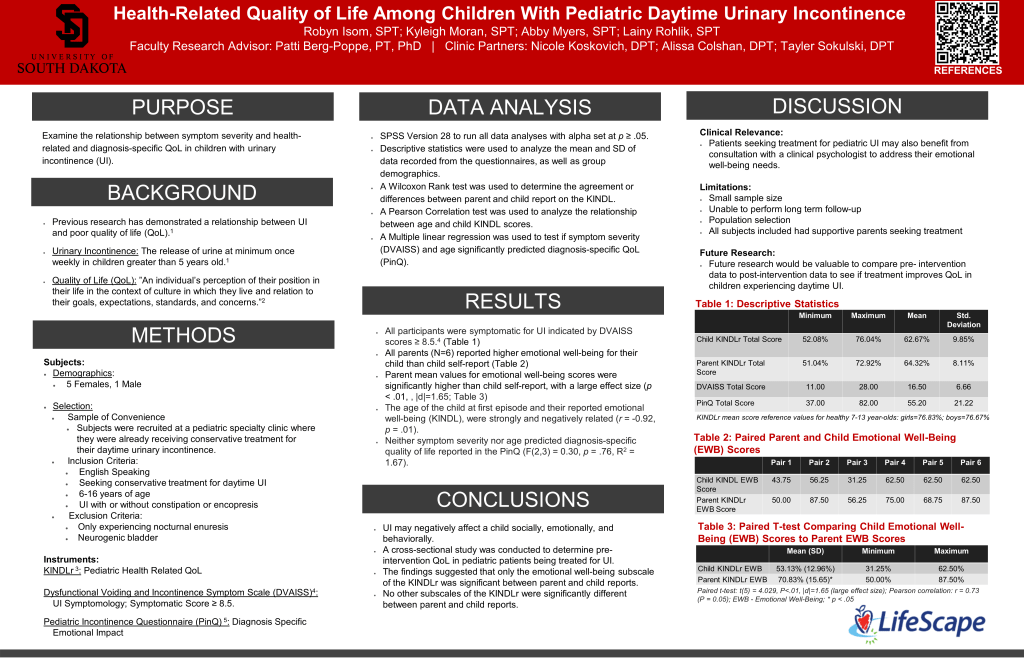
Hi guys! Great job on your poster, it was easy to follow and understand. I found it really interesting how the parents rated their child’s emotional well-being higher than the child rated themselves. Do you have any ideas for how we can help parents understand how much this affects their children? Good job!
Hi Hannah! This is a great question! At LifeScape, the clinic that we partnered with for this research, uses a multi-disciplinary approach to address impairments. This includes consultation with a clinical psychologist. I think by having the parent/caregiver sit in on these consultations, they would be able to get a clearer picture of how urinary incontinence is affecting the emotional well-being of their child(ren). I would also suggest that the parents have open and honest conversations with their child about what they are experiencing. Hope this answered your question!
Hey guys! I really enjoyed reading and learning more about this topic and your poster was really easy to follow and understand! I understand your research was aimed toward pediatric patients, but do you think you would get similar results with elderly patients who suffer from urinary incontinence? Furthermore, why do you believe there is disconnect between the patient’s emotional well-being versus what their parent’s rated their emotional well-being?
Hi Tiana! Thank you for your question! If this research were to be conducted with elderly patients, I believe the overall result would indicate a lower quality of life. However, there may be different themes throughout. For example, with pediatric patients, they are expected to be in school throughout the week; whereas elderly patients may have a week without any obligations, depending on their lifestyle. Day-to-day, the pediatric patients may have many different experiences that lower their quality of life, while elderly patients may not have any issues while they are at home. As for why their is a disconnect between the emotional well-being scores, I can’t say for sure. One thought is that the parents may be looking at emotional well-being from the perspective of a parent rather than the child’s perspective. The parent is not specifically on the receiving end of any teasing or embarrassment that the child may experiences. The parent may be unaware of the effect that this is having on the child. I hope this answered your questions and let us know if you have any more!
Good work guys. The poster looks great and well organized. I am curious on what your guys’ thoughts are on how the data would change with more participants. As well as if data would be collected and compared to the age difference between 6 and 16. Would it fluctuate differently between the ages of the participants and would it possible show an effect on the patient EWB compared to their parents EWB?
thanks!
Hi Mikaela! Because of the statistical significance of our results, we would assume that our findings would be similar with more participants. However, because our population size was so small our results may have been biased. Having additional participants would definitely make the results more reliable! The results of our study indicated that the older the child is at their first episode of UI the lower their reported emotional well-being would be. If we were to look at older children with UI it would be expected that they would report a lower emotional well-being when compared to younger children. It would also be expected that their parents would report a higher emotional well-being for the child than the child would report for themselves. Hopefully this answers your questions!
Great work! I found this topic very interesting as I was unaware of the negative effect that UI could have on the emotional well-being of children. Since your study involved 5 females and 1 male, do you believe your results would differ if there were 5 males and 1 female studied? I am curious if a male’s perception of UI differs from a female’s perception and how that affects each gender’s emotional well-being.
Hi Tess, great question! Based on the results we got, I think our results would be similar if we had more males compared to females because our results were significant. Because our results only showed statistically significant differences for the emotional well-being sub scale of the KINDL between parent and child, we can’t determine if other sub scales of the KINDL would change if more males were involved with the study. It would be interesting to look into this more in detail if we would have had more participants in our study. Hopefully this answers your question!
Hi guys, I found this topic interesting and enjoyed learning more about an area that I have not heard too much about. You mention that the children who took part in this study had supportive parents who were willing to seek treatment. Even though these parents appear to be more in tune with their children’s needs and emotional well-being, what barriers do you believe led them to rate their children’s emotional well-being as better than the children rated it themselves?
Hi Chase, we believe this may be because the parents do not see the child during school while they are with their peers. Peers have a large role on children in these age ranges. Their peers attitude towards them can greatly affect their emotional well-being.
Hey everyone, I came across this subject and found it interesting, gaining insights into an area that’s relatively new to me. You mentioned that the kids in the study had supportive parents actively seeking treatment. Despite these parents being attuned to their children’s needs and emotional health, what obstacles do you think influenced them to assess their children’s emotional well-being more positively than the children assessed it themselves?
Hi Chase, I believe this is the same question as above. Here is my response. We believe this may be because the parents do not see the child during school while they are with their peers. Peers have a large role on children in these age ranges. Their peers attitude towards them can greatly affect their emotional well-being.
Hi Chase, I believe this is the same question as above. Here is my response. We believe this may be because the parents do not see the child during school while they are with their peers. Peers have a large role on children in these age ranges. Their peers attitude towards them can greatly affect their emotional well-being. Hope this helps!
Hi everyone, I thought this topic was very interesting and something I hadn’t given much thought to before. Maintaining urinary continence is a crucial aspect of daily living, especially as children reach school-age. Did you find that older children rated their QoL lower than younger children? I was also surprised to see that the parents in this research consistently rated their child’s emotional well-being higher than what the children self-reported. Did your group analyze why this might be or what factors might influence a parents’ perception of their child’s quality of life?
Hi Taylor! We also had the hypothesis that older children dealing with UI would have lower rated QoL. However, from our population this was not the case. They had similarly scored QoL. I believe this is due to our small population. I would expect this to change if we were to obtain a larger population of older children. As for the parent’s perception of QoL, we beleive this may be because the parents are not at school while their child is with their peers. Peers have a great influence on this population. If the parent does not see how other are reacting to their child, this may have changed their ratings.
Hi Taylor! We also had the hypothesis that older children dealing with UI would have lower rated QoL. However, from our population this was not the case. They had similarly scored QoL. I believe this is due to our small population. I would expect this to change if we were to obtain a larger population of older children. As for the parent’s perception of QoL, we believe this may be because the parents are not at school while their child is with their peers. Peers have a great influence on this school aged population. If the parent does not see how other are reacting to their child, this may have changed their ratings.


 USD PT Research
Hi guys! Great job on your poster, it was easy to follow and understand. I found it really interesting how the parents rated their child’s emotional well-being higher than the child rated themselves. Do you have any ideas for how we can help parents understand how much this affects their children? Good job!
LikeLike
Hi Hannah! This is a great question! At LifeScape, the clinic that we partnered with for this research, uses a multi-disciplinary approach to address impairments. This includes consultation with a clinical psychologist. I think by having the parent/caregiver sit in on these consultations, they would be able to get a clearer picture of how urinary incontinence is affecting the emotional well-being of their child(ren). I would also suggest that the parents have open and honest conversations with their child about what they are experiencing. Hope this answered your question!
LikeLike
Hey guys! I really enjoyed reading and learning more about this topic and your poster was really easy to follow and understand! I understand your research was aimed toward pediatric patients, but do you think you would get similar results with elderly patients who suffer from urinary incontinence? Furthermore, why do you believe there is disconnect between the patient’s emotional well-being versus what their parent’s rated their emotional well-being?
LikeLike
Hi Tiana! Thank you for your question! If this research were to be conducted with elderly patients, I believe the overall result would indicate a lower quality of life. However, there may be different themes throughout. For example, with pediatric patients, they are expected to be in school throughout the week; whereas elderly patients may have a week without any obligations, depending on their lifestyle. Day-to-day, the pediatric patients may have many different experiences that lower their quality of life, while elderly patients may not have any issues while they are at home. As for why their is a disconnect between the emotional well-being scores, I can’t say for sure. One thought is that the parents may be looking at emotional well-being from the perspective of a parent rather than the child’s perspective. The parent is not specifically on the receiving end of any teasing or embarrassment that the child may experiences. The parent may be unaware of the effect that this is having on the child. I hope this answered your questions and let us know if you have any more!
LikeLike
Good work guys. The poster looks great and well organized. I am curious on what your guys’ thoughts are on how the data would change with more participants. As well as if data would be collected and compared to the age difference between 6 and 16. Would it fluctuate differently between the ages of the participants and would it possible show an effect on the patient EWB compared to their parents EWB?
thanks!
LikeLike
Hi Mikaela! Because of the statistical significance of our results, we would assume that our findings would be similar with more participants. However, because our population size was so small our results may have been biased. Having additional participants would definitely make the results more reliable! The results of our study indicated that the older the child is at their first episode of UI the lower their reported emotional well-being would be. If we were to look at older children with UI it would be expected that they would report a lower emotional well-being when compared to younger children. It would also be expected that their parents would report a higher emotional well-being for the child than the child would report for themselves. Hopefully this answers your questions!
LikeLike
Great work! I found this topic very interesting as I was unaware of the negative effect that UI could have on the emotional well-being of children. Since your study involved 5 females and 1 male, do you believe your results would differ if there were 5 males and 1 female studied? I am curious if a male’s perception of UI differs from a female’s perception and how that affects each gender’s emotional well-being.
LikeLike
Hi Tess, great question! Based on the results we got, I think our results would be similar if we had more males compared to females because our results were significant. Because our results only showed statistically significant differences for the emotional well-being sub scale of the KINDL between parent and child, we can’t determine if other sub scales of the KINDL would change if more males were involved with the study. It would be interesting to look into this more in detail if we would have had more participants in our study. Hopefully this answers your question!
LikeLike
Hi guys, I found this topic interesting and enjoyed learning more about an area that I have not heard too much about. You mention that the children who took part in this study had supportive parents who were willing to seek treatment. Even though these parents appear to be more in tune with their children’s needs and emotional well-being, what barriers do you believe led them to rate their children’s emotional well-being as better than the children rated it themselves?
LikeLike
Hi Chase, we believe this may be because the parents do not see the child during school while they are with their peers. Peers have a large role on children in these age ranges. Their peers attitude towards them can greatly affect their emotional well-being.
LikeLike
Hey everyone, I came across this subject and found it interesting, gaining insights into an area that’s relatively new to me. You mentioned that the kids in the study had supportive parents actively seeking treatment. Despite these parents being attuned to their children’s needs and emotional health, what obstacles do you think influenced them to assess their children’s emotional well-being more positively than the children assessed it themselves?
LikeLike
Hi Chase, I believe this is the same question as above. Here is my response. We believe this may be because the parents do not see the child during school while they are with their peers. Peers have a large role on children in these age ranges. Their peers attitude towards them can greatly affect their emotional well-being.
LikeLike
Hi Chase, I believe this is the same question as above. Here is my response. We believe this may be because the parents do not see the child during school while they are with their peers. Peers have a large role on children in these age ranges. Their peers attitude towards them can greatly affect their emotional well-being. Hope this helps!
LikeLike
Hi Chase, I believe this is the same question as above. Hope that helps!
LikeLike
Hi Chase, I believe this is the same question as above. I will redirect you to my reply to your last posted questions. Thanks!
LikeLike
Hi everyone, I thought this topic was very interesting and something I hadn’t given much thought to before. Maintaining urinary continence is a crucial aspect of daily living, especially as children reach school-age. Did you find that older children rated their QoL lower than younger children? I was also surprised to see that the parents in this research consistently rated their child’s emotional well-being higher than what the children self-reported. Did your group analyze why this might be or what factors might influence a parents’ perception of their child’s quality of life?
LikeLike
Hi Taylor! We also had the hypothesis that older children dealing with UI would have lower rated QoL. However, from our population this was not the case. They had similarly scored QoL. I believe this is due to our small population. I would expect this to change if we were to obtain a larger population of older children. As for the parent’s perception of QoL, we beleive this may be because the parents are not at school while their child is with their peers. Peers have a great influence on this population. If the parent does not see how other are reacting to their child, this may have changed their ratings.
LikeLike
Hi Taylor! We also had the hypothesis that older children dealing with UI would have lower rated QoL. However, from our population this was not the case. They had similarly scored QoL. I believe this is due to our small population. I would expect this to change if we were to obtain a larger population of older children. As for the parent’s perception of QoL, we believe this may be because the parents are not at school while their child is with their peers. Peers have a great influence on this school aged population. If the parent does not see how other are reacting to their child, this may have changed their ratings.
LikeLike