30 Comments on “Dry Needling: Perceptions of Cost and Therapeutic Value”
Great job with your research! I found it interesting how the role of a patient’s perception of treatment and cost varies with different therapy modalities (with larger implications for patients seeking direct access care). I also found it interesting how the results from your research can be applied to costs associated with private practices. If future research was conducted, what other therapy techniques (in addition to strength, stretch, neuro, and STM) would you evaluate?
Hi Hailey –
Thanks for sharing your thoughts and strong interest in our research, we appreciate it! To answer your question, it would be interesting to evaluate how participants would rate the effectiveness and cost with an intervention that is less hands-on and comparing it to an intervention that is more hands-on. An example of this could be strength training with abduction active range of motion with a dumbbell versus inferior glenohumeral joint mobilizations of the shoulder. In general, we would be intrigued to evaluate therapy techniques such as joint mobilizations, blood flow restriction therapy, or even aquatic therapy.
I was a fan of your presentation when we all presented in the spring. I particularly believe DN will continue to grow as a valuable intervention as our cohort enters the workforce. I know many of the patient’s I’ve seen in the past enjoy EStim as a modality. Do you think the perceived cost would increase or decrease if you displayed DN + EStim?
Additionally, pelvic health has been a growing area for PT to practice in. Do you believe an increase in DN’s value for future interventions in pelvic health is likely?
Hi Austin –
Thank you for your questions! We agree with you, dry needling continues to demonstrate its strong prevalence and importance within the physical therapy realm. To answer your question, we believe the perceived cost would increase if dry needling was displayed with electrical stimulation due to participants being able to visually see (via video) the increased activation of the musculature, which would likely portray the intervention to be productive and therefore beneficial for recovery. As the pelvic health specialty continues to grow, we also believe the use of dry needling will continue to develop to help address trigger points, referred pain, and other pelvic floor dysfunctions such as incontinence, nerve pain, and under activation of the pelvic floor muscles. We are intrigued to see how popular dry needling will become, specifically in the pelvic health physical therapy domain, in the future!
Hi guys great work on your poster! I was just wondering what would be some ways that you guys could account for the limitations that you mentioned so that future research can continue to study the effects of dry needling as a beneficial modality for physical therapists? Also, do you think that as dry needling becomes more common in PT care that the overall perceived cost of the modality will go down?
Thank you for your questions, we obviously think it is very important to address the limitations of our research so that future research can continue to expand on our findings. A few ways we could attempt to decrease our limitation of multiple unfinished surveys would be to create an incentive to complete the surveys also not allowing the participate to proceed on the survey with incomplete answers. Great question about increased popularity correlating with potential decreased perceived cost. It is difficult to assume which way perception of cost would trend following increase in popularity. However, it may be reasonable to infer that as this modality becomes used more in common practice patients may assume it’s cost is lower and more “affordable” as majority of people are able to afford it.
Great job on your research! I have had dry needling myself and found it very beneficial. It was interesting to read in the background how over 50% of previous patients would not seek PT through direct access care. In addition, it was interesting to read that the experimental group found PT more beneficial when DN was involved. Do you believe DN will be covered by insurance in the future once there is more research backing up its benefits?
Hi Madi –
Thanks for reading our poster and asking this question because we know insurance companies can be difficult to work with at times. However, your question is valid, and I think there is potential that insurance companies will start recognizing dry needling as a valued part of physical therapy practice. Research continues to grow around the topic of dry needling and its benefits, and as future clinicians, I believe it is our job to lobby for our work through the research we have for the reimbursement of dry needling. Accepting out-of-pocket payments for dry needling is not an unsatisfactory method, but we have to pay for extra courses to become certified to perform dry needling. It would be nice if insurance companies would recognize this and listen to the abundance of research that keeps coming up about the benefits of dry needling. Our whole goal as physical therapists is to treat the patient, so they can be their most optimal self. We know that dry needling is beneficial especially when combined with other therapeutic exercises and activities. Also, patients may be more willing to come to their therapy sessions if they include dry needling. This, in turn, can potentially create a quicker recovery for patients and decrease the number of sessions a patient will need which would please the insurance company and make them more open to reimbursing dry needling.
I really enjoyed your guys research presentation in the spring, I think it is so important to understand our values as a PT and how we can maximize our marketing of ourselves. We know how beneficial dry needling can be, but oddly insurance does not cover it. If insurance were to begin covering it, how do you think this could impact cash-based PT practices which are heavily marketed on dry needling? If chiropractors (in SD) were allowed to do the same functional dry needling PTs do, what are your thoughts on how this would effect the perceived value of a PT session?
Hi Tom –
Thank you for your questions aa you bring up some great points. If insurance did start covering dry needling I feel like you might see some patients transition from cash based over to clinics that accept insurance. However, if the patient’s like where they are being seen they can send their own paperwork into insurance for reimbursement even if the PT clinic doesn’t accept insurance. Its really hard to say how much it will affect the cash based clinics. If chiropractors could also do functional dry needling I don’t believe that it would affect the perceived value of PT a whole lot as we do a lot more than just dry needle. Patients seem to really value the hands on benefit from both chiropractic and PT so I think it would keep the value the same.
Great job on your research! I found it interesting learning about patient’s perceptions of various forms of therapeutic techniques. Do you believe that Physical Therapists are aware that patients perceive dry needling to be more therapeutically valuable when compared to other modalities of treatment? Furthermore, if this knowledge was more known by Physical Therapists, do you believe dry needling would be implemented in more treatment sessions?
Hi Tess –
Thank you for taking the time to look at our poster and ask some questions. I think that some physical therapists may be aware of the fact that patients seem to more highly value dry needling, however, I am sure that there are still some that aren’t aware. I think that it may be implemented more but at the same time there is often a barrier with the patient not liking needles, and not every patient needs to be dry needled. You definitely still have to take in the whole picture and make the clinical judgement call on why you are doing it and what your desired outcome from the needling would be.
I enjoyed reading your research! I have had the opportunity to receive dry needling in PT and found that it benefitted me. Out of curiosity, you stated that one part of the demographic information was whether the participant has or hasn’t received physical therapy in the past. Did you guys investigate differences between perceived cost and values from participants that have received PT vs the ones that haven’t? I’d be curious if this would show variations in perceptions. As well, you stated that further research should investigate an alternative intervention as the control. Do you hypothesize it would show a specific outcome or something similar to your research results?
Hi Rylee –
Thank you for taking the time to read our poster and come up with some questions. We did look at previous experience with dry needling however the sample size that we had of participants that had received DN before was very small so it was hard to compare them to the whole group, it definitely would be interesting to see the results of this comparison with a larger sample size. We didn’t find a significant difference between soft tissue and dry needling so if we were to use ther ex or some other intervention and compare it to dry needling we suspect that we would find a significant difference in value between the two. Our research mainly showed that people really value the hands on aspects of therapy.
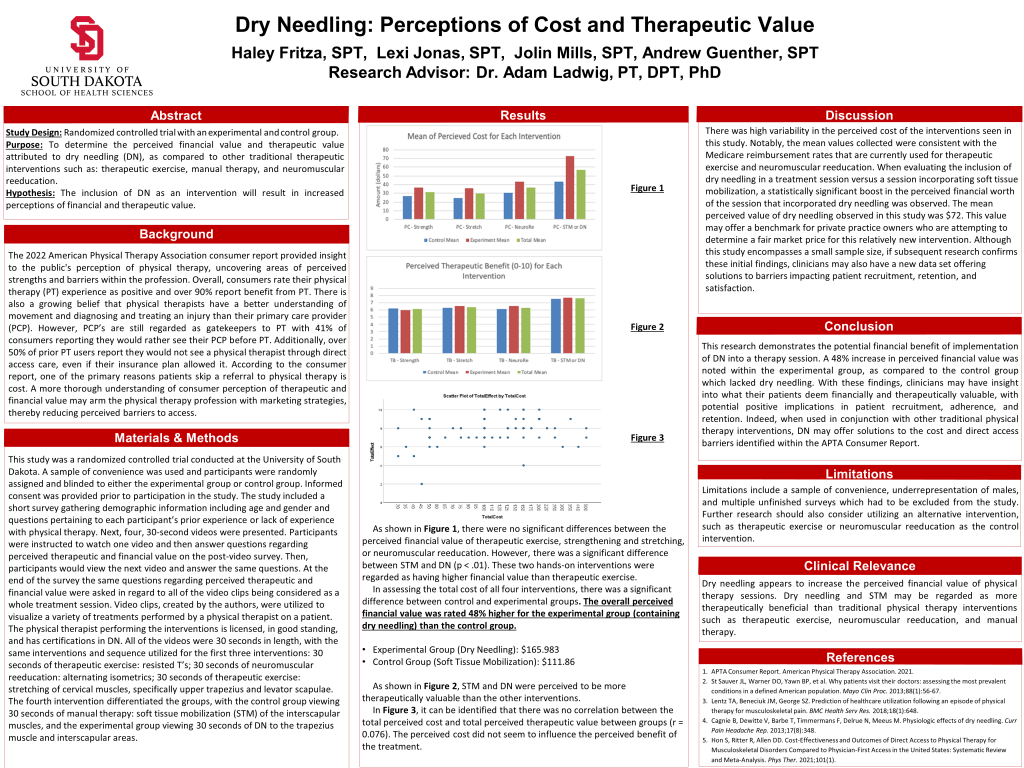
I think you did really well on your research. I found your research interesting. I haven’t seen much research on what patients may think of what the treatment is and how much it is worth. I have two questions for you. I saw in the your mean perceived cost graph that the mean for the experimental group was consistently higher for each section, is there any reason for this such as a single participant had a much larger estimation for cast over the others? My other question is what is the current standard cost for Dry Needling therapy?
Thank you for your interest in our research and your questions. You had a good observation noticing that each mean was slightly higher in the experimental group as apposed to the control. Even though there is an observable difference found, we did not specifically look at the same interventions between each group, because the video each group saw was the exact same video except for the DN and STM video. Therefore, we focused our efforts to the STM and DN numbers which were significant rating DN at a higher perceived cost. That being said, the difference you are able to observe (excluding the STM and DN) was not significant. Regarding your question about the current standard price of DN, while it is going to be mainly clinic deciding, there is a wide range of around 30-90 dollars. This pricing will also vary depending on how many needles are used and how many muscle groups are targeted. I hope I was able to answer your questions!
Hey crew, interesting bit of research here. I know you only specifically addressed dry needling in your study but was just curious if there were any other “unique” interventions you think could possibly increase the perceived financial value of a therapy session? Good work.
Thank you for your interest in our research! You have proposed a good question. For an outpatient setting primarily, we may expect to see interventions such as blood flow restriction, aquatic therapy, electrical stimulation, soft tissue massage, and soft tissue mobilization to possibly have an increased perceived financial value. We would predict these prices to be increased due to how patients seem to value hands-on therapy as well as maybe perceiving ‘unique-looking’ interventions to be more expensive. Whether or not patients have seen or performed these specific interventions before may also determine how they perceive the cost of them.
Great job on your research! I have not had dry needling myself but have observed it being done many times, and it seems to be very beneficial. Besides finances, what do you think could be another obstacle that needs to be addressed when it comes to dry needling and incorporating it more into practice?
Thank you for your question! Another obstacle besides finances could be clinician’s not going on in their education and becoming DN certified. Given that in order to practice and provide DN services clinicians need to take and invest in the course’s at a post-graduate level. As DN continues to develop and researched, I could see benefit in DPT programs incorporating DN certifications into the curriculum so new grads can provide this service without seeking out third party organizations to become certified.
Nice job on your groups research project! I really enjoyed learning even more about DN last spring when I was able to attend the presentation. It brings a great insight to the general public and how they also perceive the therapeutic and financial benefits of this intervention. My questions, although this was not the desired intent, do you think this research would potentially help influence insurance companies to one day accepting DN as a beneficial intervention and actually cover it? I would like to think that if this study was performed on a bigger scale to obtain more general public insight on the perceived benefits compared to already covered interventions, that it would help insurance companies decide to actually assist in reimbursing PT clinics that utilize the intervention. Again, great job on all your hard work with this project!
Hi Christina –
Great question! It is difficult to know for sure if insurance companies will consider covering the cost of dry needling. It is possible that eventually insurance companies will see the increased benefits of dry needling and begin covering the cost as long as it is a medical necessity for a specific patient population. In order for dry needling to be covered by insurance, my guess is that insurance companies would want to see doctors prescribe dry needling for patients and refer patients to physical therapy specifically for dry needling to demonstrate the true medical necessity for the intervention. Although dry needling and acupuncture are different interventions, the situation I described above is how insurance companies determine if they will cover the cost of acupuncture for patients attending chiropractic therapy for example. If this were the case, it would be slightly unfortunate due to all the effort we have put into advocating for direct access physical therapy and now having one more thing that requires a medical referral. I hope this makes sense and answers your question!
Hello great poster and presentation. Do you believe that the perceived cost and therapeutic value would increase if you compared direct access vs a medical referral?
Hi Tonner –
This is a good question! Personally, I believe someone who enters physical therapy via direct access and receives dry needling would have increased therapeutic value and would probably pay more to have the intervention performed on them as compared to someone who was referred to physical therapy. I think someone that is seeking out physical therapy via direct access is someone that is putting in an extra effort to improve their pain/function and therefore would appreciate the intervention more and potentially see increased benefits.
Interesting presentation and great job with the organization. When discussing the perceived cost of dry needling, do you think there is a difference when it comes to location or regions around the US? For example, is there a larger difference in perceived cost in a urban, high populated area compared to a rural area of practice?
Hi Jett –
Good question! It is difficult to say for sure because the actual cost of dry needling can vary widely across the U.S. My guess would be that people that live in a rural area would perceive the cost of dry needling to be higher than people that live in of near an urban area. The reason I would assume this is because people in a rural area may not be as exposed to healthcare and different or unique interventions like dry needling when compared to people living in urban areas who have increased access to advanced technology, several medical professionals, and specialty clinics. Dry needling may be a more commonly used intervention in urban areas which may decrease the perceived cost.
Great poster guys! I found your research very interesting. My one questions would be how would you go from here with your research? Would you try to get a larger sample size and how would that look? I also saw that you noted that using neuro re-ed or ther ex as a control would be a good next step. Do you think using a modality such as E-stim or ultrasound as a comparable would change things?
Hey Amanda!
I think a larger sample size is always a good goal to improve the findings of future research. An attempt to getting a larger sample size would be starting advocation earlier also having an incentive to complete the research survey I think would help draw participates. I also think that e-stim or ultrasound would make good options for another experimental group option. This is because we know patients value external/physical interventions and therefore would may not create an accurate representation of a control. We also know that patients value physical touch and is one of the limitations to our current findings as it hindered our control group findings.
Excellent poster! Your topic is fascinating. Do you think the results would differ if the participants experienced the dry needling themselves and rated before and after treatment? If so, how do you believe this would impact the data?
Thank you for your interest and questions. I think finding the results of patients experience following a DN treatment would be a great future study and that information would be more telling to how patients physically respond to this treatment rather than purely perception. I do think the data may be impacted slightly, we do know many patients who try DN typically respond well, therefore, we may be able to assume higher financial values reported but it is difficult to say for sure.

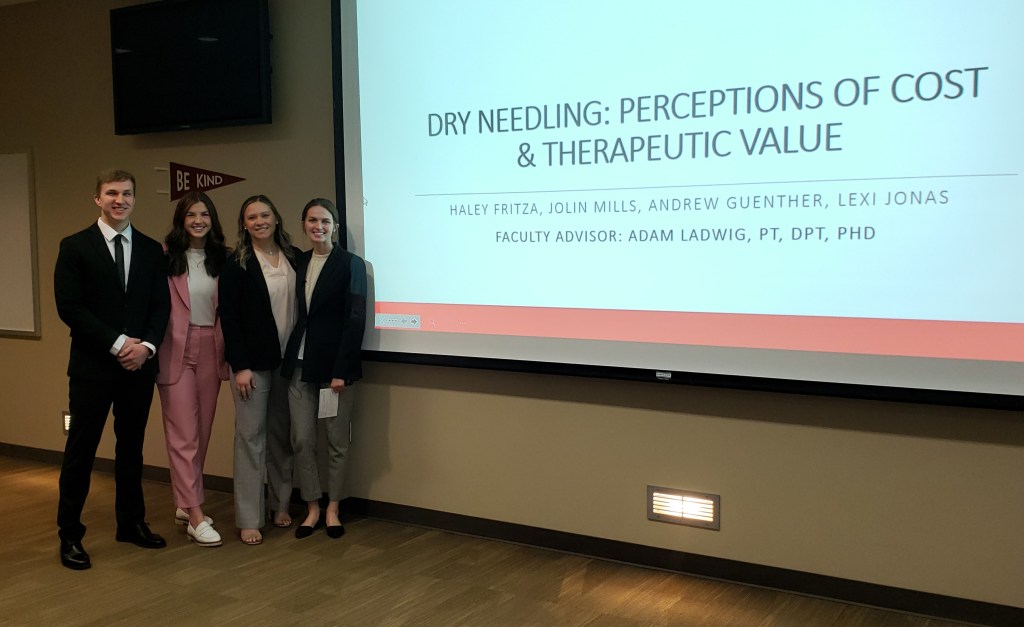

 USD PT Research
Great job with your research! I found it interesting how the role of a patient’s perception of treatment and cost varies with different therapy modalities (with larger implications for patients seeking direct access care). I also found it interesting how the results from your research can be applied to costs associated with private practices. If future research was conducted, what other therapy techniques (in addition to strength, stretch, neuro, and STM) would you evaluate?
LikeLike
Hi Hailey –
Thanks for sharing your thoughts and strong interest in our research, we appreciate it! To answer your question, it would be interesting to evaluate how participants would rate the effectiveness and cost with an intervention that is less hands-on and comparing it to an intervention that is more hands-on. An example of this could be strength training with abduction active range of motion with a dumbbell versus inferior glenohumeral joint mobilizations of the shoulder. In general, we would be intrigued to evaluate therapy techniques such as joint mobilizations, blood flow restriction therapy, or even aquatic therapy.
LikeLike
I was a fan of your presentation when we all presented in the spring. I particularly believe DN will continue to grow as a valuable intervention as our cohort enters the workforce. I know many of the patient’s I’ve seen in the past enjoy EStim as a modality. Do you think the perceived cost would increase or decrease if you displayed DN + EStim?
Additionally, pelvic health has been a growing area for PT to practice in. Do you believe an increase in DN’s value for future interventions in pelvic health is likely?
LikeLike
Hi Austin –
Thank you for your questions! We agree with you, dry needling continues to demonstrate its strong prevalence and importance within the physical therapy realm. To answer your question, we believe the perceived cost would increase if dry needling was displayed with electrical stimulation due to participants being able to visually see (via video) the increased activation of the musculature, which would likely portray the intervention to be productive and therefore beneficial for recovery. As the pelvic health specialty continues to grow, we also believe the use of dry needling will continue to develop to help address trigger points, referred pain, and other pelvic floor dysfunctions such as incontinence, nerve pain, and under activation of the pelvic floor muscles. We are intrigued to see how popular dry needling will become, specifically in the pelvic health physical therapy domain, in the future!
LikeLike
Hi guys great work on your poster! I was just wondering what would be some ways that you guys could account for the limitations that you mentioned so that future research can continue to study the effects of dry needling as a beneficial modality for physical therapists? Also, do you think that as dry needling becomes more common in PT care that the overall perceived cost of the modality will go down?
LikeLike
Hi Jacob —
Thank you for your questions, we obviously think it is very important to address the limitations of our research so that future research can continue to expand on our findings. A few ways we could attempt to decrease our limitation of multiple unfinished surveys would be to create an incentive to complete the surveys also not allowing the participate to proceed on the survey with incomplete answers. Great question about increased popularity correlating with potential decreased perceived cost. It is difficult to assume which way perception of cost would trend following increase in popularity. However, it may be reasonable to infer that as this modality becomes used more in common practice patients may assume it’s cost is lower and more “affordable” as majority of people are able to afford it.
LikeLike
Great job on your research! I have had dry needling myself and found it very beneficial. It was interesting to read in the background how over 50% of previous patients would not seek PT through direct access care. In addition, it was interesting to read that the experimental group found PT more beneficial when DN was involved. Do you believe DN will be covered by insurance in the future once there is more research backing up its benefits?
LikeLike
Hi Madi –
Thanks for reading our poster and asking this question because we know insurance companies can be difficult to work with at times. However, your question is valid, and I think there is potential that insurance companies will start recognizing dry needling as a valued part of physical therapy practice. Research continues to grow around the topic of dry needling and its benefits, and as future clinicians, I believe it is our job to lobby for our work through the research we have for the reimbursement of dry needling. Accepting out-of-pocket payments for dry needling is not an unsatisfactory method, but we have to pay for extra courses to become certified to perform dry needling. It would be nice if insurance companies would recognize this and listen to the abundance of research that keeps coming up about the benefits of dry needling. Our whole goal as physical therapists is to treat the patient, so they can be their most optimal self. We know that dry needling is beneficial especially when combined with other therapeutic exercises and activities. Also, patients may be more willing to come to their therapy sessions if they include dry needling. This, in turn, can potentially create a quicker recovery for patients and decrease the number of sessions a patient will need which would please the insurance company and make them more open to reimbursing dry needling.
LikeLike
I really enjoyed your guys research presentation in the spring, I think it is so important to understand our values as a PT and how we can maximize our marketing of ourselves. We know how beneficial dry needling can be, but oddly insurance does not cover it. If insurance were to begin covering it, how do you think this could impact cash-based PT practices which are heavily marketed on dry needling? If chiropractors (in SD) were allowed to do the same functional dry needling PTs do, what are your thoughts on how this would effect the perceived value of a PT session?
LikeLike
Hi Tom –
Thank you for your questions aa you bring up some great points. If insurance did start covering dry needling I feel like you might see some patients transition from cash based over to clinics that accept insurance. However, if the patient’s like where they are being seen they can send their own paperwork into insurance for reimbursement even if the PT clinic doesn’t accept insurance. Its really hard to say how much it will affect the cash based clinics. If chiropractors could also do functional dry needling I don’t believe that it would affect the perceived value of PT a whole lot as we do a lot more than just dry needle. Patients seem to really value the hands on benefit from both chiropractic and PT so I think it would keep the value the same.
LikeLike
Great job on your research! I found it interesting learning about patient’s perceptions of various forms of therapeutic techniques. Do you believe that Physical Therapists are aware that patients perceive dry needling to be more therapeutically valuable when compared to other modalities of treatment? Furthermore, if this knowledge was more known by Physical Therapists, do you believe dry needling would be implemented in more treatment sessions?
LikeLike
Hi Tess –
Thank you for taking the time to look at our poster and ask some questions. I think that some physical therapists may be aware of the fact that patients seem to more highly value dry needling, however, I am sure that there are still some that aren’t aware. I think that it may be implemented more but at the same time there is often a barrier with the patient not liking needles, and not every patient needs to be dry needled. You definitely still have to take in the whole picture and make the clinical judgement call on why you are doing it and what your desired outcome from the needling would be.
LikeLike
I enjoyed reading your research! I have had the opportunity to receive dry needling in PT and found that it benefitted me. Out of curiosity, you stated that one part of the demographic information was whether the participant has or hasn’t received physical therapy in the past. Did you guys investigate differences between perceived cost and values from participants that have received PT vs the ones that haven’t? I’d be curious if this would show variations in perceptions. As well, you stated that further research should investigate an alternative intervention as the control. Do you hypothesize it would show a specific outcome or something similar to your research results?
LikeLike
Hi Rylee –
Thank you for taking the time to read our poster and come up with some questions. We did look at previous experience with dry needling however the sample size that we had of participants that had received DN before was very small so it was hard to compare them to the whole group, it definitely would be interesting to see the results of this comparison with a larger sample size. We didn’t find a significant difference between soft tissue and dry needling so if we were to use ther ex or some other intervention and compare it to dry needling we suspect that we would find a significant difference in value between the two. Our research mainly showed that people really value the hands on aspects of therapy.
LikeLike
I think you did really well on your research. I found your research interesting. I haven’t seen much research on what patients may think of what the treatment is and how much it is worth. I have two questions for you. I saw in the your mean perceived cost graph that the mean for the experimental group was consistently higher for each section, is there any reason for this such as a single participant had a much larger estimation for cast over the others? My other question is what is the current standard cost for Dry Needling therapy?
LikeLike
Hey Micah!
Thank you for your interest in our research and your questions. You had a good observation noticing that each mean was slightly higher in the experimental group as apposed to the control. Even though there is an observable difference found, we did not specifically look at the same interventions between each group, because the video each group saw was the exact same video except for the DN and STM video. Therefore, we focused our efforts to the STM and DN numbers which were significant rating DN at a higher perceived cost. That being said, the difference you are able to observe (excluding the STM and DN) was not significant. Regarding your question about the current standard price of DN, while it is going to be mainly clinic deciding, there is a wide range of around 30-90 dollars. This pricing will also vary depending on how many needles are used and how many muscle groups are targeted. I hope I was able to answer your questions!
LikeLike
Hey crew, interesting bit of research here. I know you only specifically addressed dry needling in your study but was just curious if there were any other “unique” interventions you think could possibly increase the perceived financial value of a therapy session? Good work.
LikeLike
Hi Logan –
Thank you for your interest in our research! You have proposed a good question. For an outpatient setting primarily, we may expect to see interventions such as blood flow restriction, aquatic therapy, electrical stimulation, soft tissue massage, and soft tissue mobilization to possibly have an increased perceived financial value. We would predict these prices to be increased due to how patients seem to value hands-on therapy as well as maybe perceiving ‘unique-looking’ interventions to be more expensive. Whether or not patients have seen or performed these specific interventions before may also determine how they perceive the cost of them.
LikeLike
Great job on your research! I have not had dry needling myself but have observed it being done many times, and it seems to be very beneficial. Besides finances, what do you think could be another obstacle that needs to be addressed when it comes to dry needling and incorporating it more into practice?
LikeLike
Hey Abbigail,
Thank you for your question! Another obstacle besides finances could be clinician’s not going on in their education and becoming DN certified. Given that in order to practice and provide DN services clinicians need to take and invest in the course’s at a post-graduate level. As DN continues to develop and researched, I could see benefit in DPT programs incorporating DN certifications into the curriculum so new grads can provide this service without seeking out third party organizations to become certified.
LikeLike
Nice job on your groups research project! I really enjoyed learning even more about DN last spring when I was able to attend the presentation. It brings a great insight to the general public and how they also perceive the therapeutic and financial benefits of this intervention. My questions, although this was not the desired intent, do you think this research would potentially help influence insurance companies to one day accepting DN as a beneficial intervention and actually cover it? I would like to think that if this study was performed on a bigger scale to obtain more general public insight on the perceived benefits compared to already covered interventions, that it would help insurance companies decide to actually assist in reimbursing PT clinics that utilize the intervention. Again, great job on all your hard work with this project!
LikeLike
Hi Christina –
Great question! It is difficult to know for sure if insurance companies will consider covering the cost of dry needling. It is possible that eventually insurance companies will see the increased benefits of dry needling and begin covering the cost as long as it is a medical necessity for a specific patient population. In order for dry needling to be covered by insurance, my guess is that insurance companies would want to see doctors prescribe dry needling for patients and refer patients to physical therapy specifically for dry needling to demonstrate the true medical necessity for the intervention. Although dry needling and acupuncture are different interventions, the situation I described above is how insurance companies determine if they will cover the cost of acupuncture for patients attending chiropractic therapy for example. If this were the case, it would be slightly unfortunate due to all the effort we have put into advocating for direct access physical therapy and now having one more thing that requires a medical referral. I hope this makes sense and answers your question!
LikeLike
Hello great poster and presentation. Do you believe that the perceived cost and therapeutic value would increase if you compared direct access vs a medical referral?
LikeLike
Hi Tonner –
This is a good question! Personally, I believe someone who enters physical therapy via direct access and receives dry needling would have increased therapeutic value and would probably pay more to have the intervention performed on them as compared to someone who was referred to physical therapy. I think someone that is seeking out physical therapy via direct access is someone that is putting in an extra effort to improve their pain/function and therefore would appreciate the intervention more and potentially see increased benefits.
LikeLike
Interesting presentation and great job with the organization. When discussing the perceived cost of dry needling, do you think there is a difference when it comes to location or regions around the US? For example, is there a larger difference in perceived cost in a urban, high populated area compared to a rural area of practice?
LikeLike
Hi Jett –
Good question! It is difficult to say for sure because the actual cost of dry needling can vary widely across the U.S. My guess would be that people that live in a rural area would perceive the cost of dry needling to be higher than people that live in of near an urban area. The reason I would assume this is because people in a rural area may not be as exposed to healthcare and different or unique interventions like dry needling when compared to people living in urban areas who have increased access to advanced technology, several medical professionals, and specialty clinics. Dry needling may be a more commonly used intervention in urban areas which may decrease the perceived cost.
LikeLike
Great poster guys! I found your research very interesting. My one questions would be how would you go from here with your research? Would you try to get a larger sample size and how would that look? I also saw that you noted that using neuro re-ed or ther ex as a control would be a good next step. Do you think using a modality such as E-stim or ultrasound as a comparable would change things?
LikeLike
Hey Amanda!
I think a larger sample size is always a good goal to improve the findings of future research. An attempt to getting a larger sample size would be starting advocation earlier also having an incentive to complete the research survey I think would help draw participates. I also think that e-stim or ultrasound would make good options for another experimental group option. This is because we know patients value external/physical interventions and therefore would may not create an accurate representation of a control. We also know that patients value physical touch and is one of the limitations to our current findings as it hindered our control group findings.
Thanks for your questions.
LikeLike
Excellent poster! Your topic is fascinating. Do you think the results would differ if the participants experienced the dry needling themselves and rated before and after treatment? If so, how do you believe this would impact the data?
LikeLike
Hey Lexi,
Thank you for your interest and questions. I think finding the results of patients experience following a DN treatment would be a great future study and that information would be more telling to how patients physically respond to this treatment rather than purely perception. I do think the data may be impacted slightly, we do know many patients who try DN typically respond well, therefore, we may be able to assume higher financial values reported but it is difficult to say for sure.
LikeLike