10 Comments on “Growth and Challenges in Developing Cultural Competence and Leadership Among PT Students Through Virtual Cross-Cultural Educational Sessions”
Hey guys, your poster looks great and is very well organized. With this research, would you think of expanding it to include more countries/cultures for a larger scale interaction at each discussion session? Also, do you think in doing this it would change your data at all?
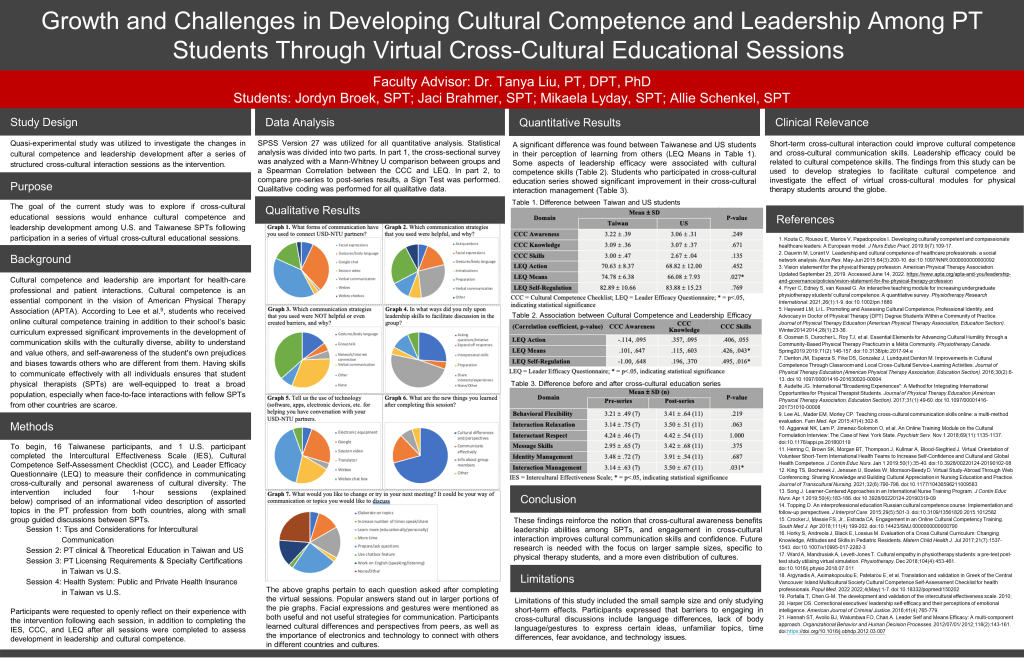
Thanks, Bailey! Great question! I definitely believe it would be beneficial to include more countries/cultures. Our main goal was to assess if cross-cultural education sessions would improve cultural competence. I would assume with the addition of multiple different cultures, cultural competence would improve more significantly simply due to learning more about various cultures as opposed to just the one in our study. Although we required participants to be able to speak English, it was not their primary language and still found difficulty in expressing themselves, thus, a language barrier was still apparent. Despite the perceived benefit of adding more countries/cultures to this research, I could also see it as a barrier due to the increased diversity of preferred languages. I think this is definitely something that should be researched more in the future to understand how multiple different cultures interact and how that changes overall cultural competence.
Hi guys! I think you did a great job with your poster and your research! I was wondering given that one of your limitation was the smaller group sizes have you thought of expanding this research from just the field of PT like maybe adding in OT, speech, or even med students? Do you think you would get more participation by doing this? Would that have an impact on the results?
Thanks, Jolin! I think that would be a great way of expanding our research. Leadership and cultural competence are a large component in all healthcare fields, which makes me curious to see if there is a difference comparing/contrasting all the different professions. I do believe having more participants as well as more sessions for our discussions with the other cultures would impact our data to show more significance in more topics and truly allow us to study gaps and advantages in our qualitative and quantitative data.
Hi guys! Great job on your research! I think your poster is very well organized. I was wondering how much of an impact the language barrier played into the results of your research? Do you feel that the results of your research would have changed if English was the primary language for all participants?
Thanks Abby! The language barrier was not too challenging to work around as English was the second language for most of the participants. We also had the option to have a translator/closed captioning of sorts for our Taiwanese participants. I do not think our results would have changed a whole lot if English was the primary language for all participants due to this reason. However, if English was the primary language, I think it may have changed the results in the sense that it would be slightly easier to communicate, but I think this would have made it so we would not see as great of a change in cultural competence.
Hi guys! Nice job on your research and poster! Although cultural competence is a necessary skill in providing good physical therapy, there is not a ton of focus on it throughout PT school. What are some ways that current PT students can further develop their cultural competence and what are some ways that current PTs can promote cultural competence in the work field?
Hi Alex! Thanks for the question. I think there are many ways we can further develop cultural competence, but one of the biggest ways we can do that is to become more consciously aware of cultural differences. In our profession, we undoubtedly work with people from various backgrounds and cultures. The more we work with different populations, the more we can become culturally competent. Additionally, the more we practice empathy and compassion, a vital part of being a PT, the more we show cultural competence. The biggest part of being culturally competent, in my opinion, is to treat everyone as you would want to be treated and to simply be a good human, and I think we as PTs tend to be very good at that. (:
Hey guys, great job with the poster, it’s easy to follow and I feel like you explained everything well without making the poster too wordy. Obviously, your greatest limitation was the sample size of US students. How do you think that you could improve participation? I know that a similar study was done last year and had similar participation. Do you think that you might see an increase in participation if the non-US students were from an english speaking country?
Thanks Spencer! Great question as I agree our groups’ biggest limitation was participation also. I think we could improve our participation by reducing the time of involvement required to participate (ex. the hour long sessions) as these may seem like a significant time requirement with all other things going on in PT school, or scheduling the sessions at times students preferred. We could also improve participant involvement by opening the study up to including students of other professions such as OT, SLP, etc. I also think implementing the importance of leadership and cross cultural awareness more into the curriculum would be of benefit to our research project. I think increasing our sample size would have changed the outcomes of our research study and provided us with more data overall! Thanks for your question!



 USD PT Research
Hey guys, your poster looks great and is very well organized. With this research, would you think of expanding it to include more countries/cultures for a larger scale interaction at each discussion session? Also, do you think in doing this it would change your data at all?
LikeLike
Thanks, Bailey! Great question! I definitely believe it would be beneficial to include more countries/cultures. Our main goal was to assess if cross-cultural education sessions would improve cultural competence. I would assume with the addition of multiple different cultures, cultural competence would improve more significantly simply due to learning more about various cultures as opposed to just the one in our study. Although we required participants to be able to speak English, it was not their primary language and still found difficulty in expressing themselves, thus, a language barrier was still apparent. Despite the perceived benefit of adding more countries/cultures to this research, I could also see it as a barrier due to the increased diversity of preferred languages. I think this is definitely something that should be researched more in the future to understand how multiple different cultures interact and how that changes overall cultural competence.
LikeLike
Hi guys! I think you did a great job with your poster and your research! I was wondering given that one of your limitation was the smaller group sizes have you thought of expanding this research from just the field of PT like maybe adding in OT, speech, or even med students? Do you think you would get more participation by doing this? Would that have an impact on the results?
LikeLike
Thanks, Jolin! I think that would be a great way of expanding our research. Leadership and cultural competence are a large component in all healthcare fields, which makes me curious to see if there is a difference comparing/contrasting all the different professions. I do believe having more participants as well as more sessions for our discussions with the other cultures would impact our data to show more significance in more topics and truly allow us to study gaps and advantages in our qualitative and quantitative data.
LikeLike
Hi guys! Great job on your research! I think your poster is very well organized. I was wondering how much of an impact the language barrier played into the results of your research? Do you feel that the results of your research would have changed if English was the primary language for all participants?
LikeLike
Thanks Abby! The language barrier was not too challenging to work around as English was the second language for most of the participants. We also had the option to have a translator/closed captioning of sorts for our Taiwanese participants. I do not think our results would have changed a whole lot if English was the primary language for all participants due to this reason. However, if English was the primary language, I think it may have changed the results in the sense that it would be slightly easier to communicate, but I think this would have made it so we would not see as great of a change in cultural competence.
LikeLike
Hi guys! Nice job on your research and poster! Although cultural competence is a necessary skill in providing good physical therapy, there is not a ton of focus on it throughout PT school. What are some ways that current PT students can further develop their cultural competence and what are some ways that current PTs can promote cultural competence in the work field?
LikeLike
Hi Alex! Thanks for the question. I think there are many ways we can further develop cultural competence, but one of the biggest ways we can do that is to become more consciously aware of cultural differences. In our profession, we undoubtedly work with people from various backgrounds and cultures. The more we work with different populations, the more we can become culturally competent. Additionally, the more we practice empathy and compassion, a vital part of being a PT, the more we show cultural competence. The biggest part of being culturally competent, in my opinion, is to treat everyone as you would want to be treated and to simply be a good human, and I think we as PTs tend to be very good at that. (:
LikeLike
Hey guys, great job with the poster, it’s easy to follow and I feel like you explained everything well without making the poster too wordy. Obviously, your greatest limitation was the sample size of US students. How do you think that you could improve participation? I know that a similar study was done last year and had similar participation. Do you think that you might see an increase in participation if the non-US students were from an english speaking country?
LikeLike
Thanks Spencer! Great question as I agree our groups’ biggest limitation was participation also. I think we could improve our participation by reducing the time of involvement required to participate (ex. the hour long sessions) as these may seem like a significant time requirement with all other things going on in PT school, or scheduling the sessions at times students preferred. We could also improve participant involvement by opening the study up to including students of other professions such as OT, SLP, etc. I also think implementing the importance of leadership and cross cultural awareness more into the curriculum would be of benefit to our research project. I think increasing our sample size would have changed the outcomes of our research study and provided us with more data overall! Thanks for your question!
LikeLike