37 Comments on “Physical Performance Measures in National Veteran Golden Age Games Athletes”
Great job everyone! I find this research very interesting and important as a great portion of the population we see in therapy is older adults. Because there was no association between the flexibility fitness subscale scores and injury or falls in this population do you believe flexibility should be a focus of treatment with older adults? Also, because the balance subscales were not significantly associated with falls, what do you think should be focused on the most in terms of treatment in order to reduce fall risk in the older population?
Dan, because we are targeting an athletic population in our research, I do still believe flexibility should be an additional focus of treatment. As for the general older adult population, I think function should be the main priority but believe working on flexibility would do no harm to the patients. As for reducing falls, I still think challenging static and dynamic exercises will be the best treatment. We may see no association with it in our research maybe because of increased ability in these athletes compared to older adults or because of static balance exercises not being difficult enough.
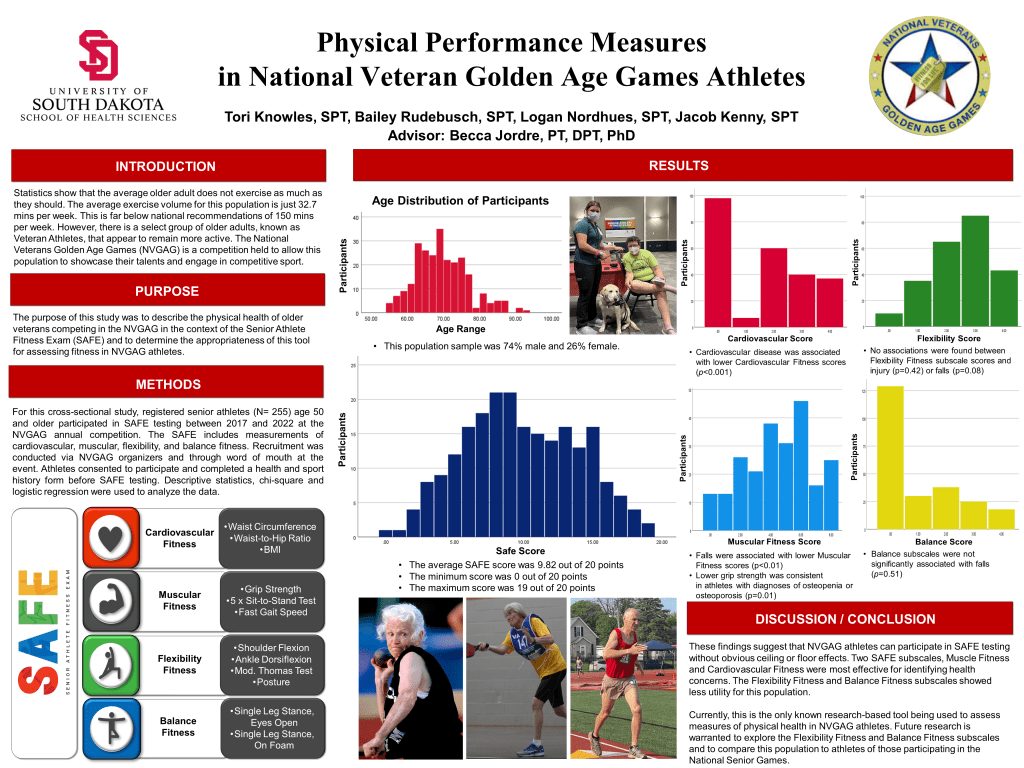
Great job with the poster! I really enjoyed looking at the graphs and the explanations behind them. It was mentioned in the discussion section that there were no obvious ceiling or floor effects with the athletes participating in SAFE testing. Did you hypothesize any specific ceiling or floor effects to occur?
Great question Luke! While the SAFE has proven to be an effective means for gathering data in the Senior Athletes, there has been no other data with it in regards to the Veteran Athlete population. Thus said, prior to the conduction of our research we did suspect that there might be some floor effects with this exam. In knowing that veterans (in general) have a greater number of comorbidities than those who are non-veterans, we did think that this could have affected the scores of participants prior to our data collection.
Great question Luke! While the SAFE has proven to be an effective means for gathering data in the Senior Athletes, there has been no other data with it in regards to the Veteran Athlete population. Thus said, prior to the conduction of our research we did suspect that there might be some floor effects with this exam. In knowing that veterans (in general) have a greater number of comorbidities than those who are non-veterans, we did think that this could have affected the scores of participants prior to our data collection.
You all did a great job! The information presented was well organized and the graphs were easy to understand. Do you believe having more females participate would effect the results? In addition, why do you think balance sub-scales were not significantly associated with falls?
Mikhayla, it would be interesting to see if the results were different if it was an even 50/50 split of males and females. I would assume there would be some differences in results but I’m not exactly sure what category we would see that in for sure. As for why the sub-scales are not associated with falls, my best guess would be it is because these athletes aren’t your typical older adults and are falling less. I would also say that the balance activities may not be challenging enough for the population.
I loved this presentation! It was such an interesting project. My question for you was if you believe the SAFE test was lacking in any areas? For example the balance portion of this test only assess static balance. Do you think this test would be even more reliable if is assess dynamic balance as well?
Hey Abby, awesome question! We had expected to see an association within our balance subtest, yet no significant correlations to falls, comorbidities, or bone health were found here. While the scores showed to be the poorest within the balance subtest (especially with eyes closed), I think that assessing dynamic balance would be a great idea to look into including in the future! Not only might this show more of a correlation in our data, but I feel that it’s also much more functional for this population (being athletes) as well!
Thanks for the question Abby. We do believe there are areas of improvement for the SAFE being used for this population. The SAFE was originally developed for the older adults competing in the National Senior Games and is still being tested for its effectiveness in testing older Veteran athletes. We were surprised that the balance portion did not predict any association with falls or other health comorbidities. Dynamic balance is a good predictor of falls, however we actually found an association between falls and muscular strength testing outcomes. The future of this will be tailoring the SAFE specifically to this population.
Great job everyone! Your poster looks great. I really enjoy this topic of the SAFE test and learning more about it. For my past clinical in-service project I looked at the correlation between the 6 minute walk test, 2 minutes walk test and gait speed and how researchers have been able to use those results to predict the length of hospital stays as well as survival rate for older adults. Did you find any correlations with the results from the SAFE test besides risk of falls and cardiovascular disease? Great job again and great poster!
Hi Madison great question! Yes we found a few other correlations besides risk of falls and CVD association. First, we found that lower muscle density scores were associated with an increased risk of falls. Second, we found that lower grip strength scores were associated with lower bone health scores. Thanks again, we are glad you liked our poster!
Great job with your research! This is such an interesting demographic and choice of research. Do you feel like having such a wide age range skewed the results in any way? Because there were more men in the study, and we know that men are more likely to be affected by cardiovascular disease, what impact do you think this had on the results for the cardiovascular score?
Hey Brianna, thank you for having an interest in our research. The age range in any research can prove to skew results. This research is based on performance and it should be remembered that these Veterans are athletes who out perform the average older adult. The cardiovascular subtest is scored on waist circumference, waist-to-hip ratio, and BMI. Gender can play a factor in these scores, but the overall reach of this test is health and anthropometric measurements.
With time, we can look into the specific gender results and compare the outcomes for differences. We can also divide up the different age groups and compare those results and the health histories.
Great poster and research topic, I really enjoy this area of research and being able to participate in the data collection to this study. Very cool that we are able to administer the SAFE knowing there will not be ceiling nor floor effects, definitely useful and unique to other outcome measures. My question to you all is were there any limitations to this study and if so what types of strategies can future research due to avoid these limitations. If there where none, what types of strategies did you do as a group to anticipate and avoid the limitations to create the most efficient findings? Hope you all are enjoying clinical’s!
Hey Haley, thank your for showing interest in our research. One of the limitations we did find in our research was the inter-rater reliability. We were fortunate to have so many volunteers help with testing our subjects over the years. All testers went through the same training before the event. However, no one was monitored during the event to ensure procedures were being followed directly. Another limitation was that our health histories were self reported, which can result in discrepancies in the outcomes and affect our scoring. Lastly, athlete motivation can result in skewed performance results based on the effort they put in. To avoid these in the future we can have more extensive training before testing and have someone overseeing the testing event to ensure procedure is being followed. Another would include having the athletes bring in a doctor’s note with the medical history for accuracy. Athlete motivation is a hard one to control for but we did not have too much concern for this as a major limitation. The athletes are very competitive and is more of a precaution than limitation to this research.
This is a super interesting research since it encompasses a population not often studied! You guys did an awesome job with the visuals on your poster, and they were easy to follow! After completing the research, why do you think that the balance scores were not significantly associated with falls? Additionally, do you think that, due to your research, strength training should be utilized more than balance training for patients with frequent falls?
Tiana, possible explanations could be the fitness level of the older adults we were testing. Another explanation could be because the balance exercises weren’t difficult enough or possibly even false reporting on falls. I still believe the strength training and balance activities should still be used together.
I find the older adult population, especially athletes, very interesting to work with!! I think this area of research is extremely important, as senior athletes are often not looked at in studies on older adults. Do you have any hypotheses as to why flexibility and balance did not have a significant correlation with falls or injuries?
Hi Robyn that is a great question! I initially thought that balance was going to be associated highly with fall risk in our study! One reason balance may not have correlated with fall risk could be that our test for balance was too challenging for most of the athletes. This would be a great question to explore in future research. It would have been interesting to see if our balance score would’ve changed had we used an additional outcome measure in conjunction with the SAFE.
Robyn, I think with the amount of data we have is possible the reason for this explanation. One would definitely think that balance deficits would have a correlation with falls. Another reason could possibly be false reporting from patients not wanting to report a fall. Those are just several but think there could be other explanations.
Hello, your team’s poster looks amazing! It is very visually appealing which pulled me into reading it without even knowing the topic. I think that this topic is not nearly talked about enough, and these older adults are making such an amazing impact. I am wondering if your group did any sort of comparison to older adults in the general population? I would be curious to know how these athlete’s endurance compares to their peers. Also, I am wondering if there is a correlation to what event the athlete was participating in and their level of physical fitness?
Great question Macy, and thank you for showing interest in our research! We did do research into the correlation between both older adults and the general population. While we assumed the veteran athlete population would be exercising in greater amounts, we were shocked to shocked to see the actual statistics here! Our statistics showed that veteran athletes exercise approximately 1037% more than the average older adult, and two times the recommended amount of exercise based on the CDC guidelines.
We too were curious as well to see if there was a correlation to the event the athlete was participating in and their level of physical fitness. However, we decided not to look into depth here since the purpose of our research was to see if the SAFE was a reliable measure for this population. Thus said, we did find that almost all of the athletes tested were actually participating in a variety of different events, so this is something that could definitely be looked into closer in the future!
Awesome poster! This is a very interesting topic about something not talked about all that often. Your poster and graphs were very easy to read and understand. I liked how you provided explanations beneath each graph to make it easier to interpret the results. Knowing the results you found in this study, what would be potential next steps as far as future research or topics to dive deeper in depth about?
Hello Peyton! Great question, and thank you for showing interest in our research! Future research we would like to pursue would be to conduct a direct comparison between the athletes of the National Senior Games and those of the veteran athlete population at the National Golden Age Veteran Games. We think it would be interesting to see the differences in number of comorbidities, athlete ages, scores between the subtests, as well as to investigate if these differences led to variability of success within competition.
Love the pictures and the layout of your poster. It makes it very easy to read and get an understanding of the big picture of your research study. Wouldn’t it be amazing if all adults into older adulthood carried out the activity levels that we are supposed to! I cannot remember back to your presentation, but did you happen to compares different sport participation to how individuals scored on the SAFE? If so, what sport specific athletes had the best scores on the SAFE?
Thank you for the comment Kaylee! The research we did was primarily focused on determining if the SAFE could be used to test this specific veteran athlete population. The intake form we had our subjects fill out did include a portion to report the events they were participating in. Our results showed that all of our subjects were competing in multiple events, so it was difficult to determine correlations between events and scores. We did discuss this to be an area to look into with the continuation of this research.
Hello, I like what you did with the poster and had most of the attention on the graphs. I have always hated the “wall of text” you sometimes see at poster sessions so this was a welcome change. I was wondering if you had a threshold to the SAFE score for it to be unsafe to allow a participant to participate in the study?
I am glad to hear you enjoyed our poster and have interest in our research. The SAFE was open for any and all athletes participating in the NVGAG, so we did not turn anyone away who wanted to test. Safety was ensured for both the athletes and testers who were participating. The athletes who could not complete some of the subtests did end up with a lower overall SAFE score, but were provided with education at the end based on the subtests they did complete.
Is their any additional subscales you believe would be beneficial to add to this screening tool or any additional items to add to the subscales to better screen these individuals?
Hello Tonner! We’re glad to hear your interest with our project! Considering that the balance subtest did not show correlations with falls, it is likely that this subtest was too difficult. Athletes scored the poorest here, with an average score of 1.05 out of 4 points. This is definitely something to be looked into in the future, and we feel that decreasing the difficulty here would be beneficial in showing correlation. Other ideas may be to include means for assessing more dynamic (vs static) balance, considering the mechanisms for which most falls occur.
Great job with your presentation! Your data was easy to read and organized well. What were some of the limitations you came across throughout your study? Along with that, how do you think those limitations could have been prevented?
Hello Morgan, thank you for your interest in our poster! Some of the limitations we had within our research involved inter-rater reliability between testers, athlete motivation, and the accuracy of self-reported health history and activity level information. We feel that some of these limitations could have been prevented by having less (or the same) testers conducting the tests and measures for our research. We could also look into adding additional means to ensure the athletes put forth their best efforts with the tests. Whether this be by adding some incentives or an additional survey at the end, this could be crucial to accuracy with data collection considering the athlete’s scores are directly related to how they performed.
Great job with this presentation! I found the poster very easy to follow and understand! I find it very interesting that the balance subscales were not significantly associated with falls. Why do you think that is the case?
Hello Brandon, thank you for your interest in our poster! We too were surprised to see that there was no correlation here. Balance was the subtest that the athletes scored the poorest on, with an average score of 1.05 out of 4 points. Thus, this subtest could have just have been too difficult for participants, and this is an area we are hoping to dive deeper into in the future. This could also be in part be due to false reporting with athletes not wanting to admit to having fallen in the past.
Hey guys, really nice poster! I found it interesting that your research showed correlation between osteopenia/osteoporosis and a lower grip strength. After seeing that in the active older adult population, do you think grip strength would be a good outcome measure to use with older adults being seen in clinic to show declines in strength and the potential for osteopenia/osteoporosis?
Hello Amanda, thank you for for your interest! We absolutely think that grip strength assessments would be good outcome measures to use within the clinic, especially in knowing the high prevalence of osteopenia/osteoporosis that there is today. We feel that the grip strength assessment is a great indicator of overall muscular strength, and is a tool that can be very helpful in helping to show progress with individuals within their course of therapy as well.



 USD PT Research
Great job everyone! I find this research very interesting and important as a great portion of the population we see in therapy is older adults. Because there was no association between the flexibility fitness subscale scores and injury or falls in this population do you believe flexibility should be a focus of treatment with older adults? Also, because the balance subscales were not significantly associated with falls, what do you think should be focused on the most in terms of treatment in order to reduce fall risk in the older population?
LikeLike
Dan, because we are targeting an athletic population in our research, I do still believe flexibility should be an additional focus of treatment. As for the general older adult population, I think function should be the main priority but believe working on flexibility would do no harm to the patients. As for reducing falls, I still think challenging static and dynamic exercises will be the best treatment. We may see no association with it in our research maybe because of increased ability in these athletes compared to older adults or because of static balance exercises not being difficult enough.
LikeLike
Great job with the poster! I really enjoyed looking at the graphs and the explanations behind them. It was mentioned in the discussion section that there were no obvious ceiling or floor effects with the athletes participating in SAFE testing. Did you hypothesize any specific ceiling or floor effects to occur?
LikeLiked by 1 person
Great question Luke! While the SAFE has proven to be an effective means for gathering data in the Senior Athletes, there has been no other data with it in regards to the Veteran Athlete population. Thus said, prior to the conduction of our research we did suspect that there might be some floor effects with this exam. In knowing that veterans (in general) have a greater number of comorbidities than those who are non-veterans, we did think that this could have affected the scores of participants prior to our data collection.
LikeLike
Great question Luke! While the SAFE has proven to be an effective means for gathering data in the Senior Athletes, there has been no other data with it in regards to the Veteran Athlete population. Thus said, prior to the conduction of our research we did suspect that there might be some floor effects with this exam. In knowing that veterans (in general) have a greater number of comorbidities than those who are non-veterans, we did think that this could have affected the scores of participants prior to our data collection.
LikeLike
You all did a great job! The information presented was well organized and the graphs were easy to understand. Do you believe having more females participate would effect the results? In addition, why do you think balance sub-scales were not significantly associated with falls?
LikeLike
Mikhayla, it would be interesting to see if the results were different if it was an even 50/50 split of males and females. I would assume there would be some differences in results but I’m not exactly sure what category we would see that in for sure. As for why the sub-scales are not associated with falls, my best guess would be it is because these athletes aren’t your typical older adults and are falling less. I would also say that the balance activities may not be challenging enough for the population.
LikeLike
I loved this presentation! It was such an interesting project. My question for you was if you believe the SAFE test was lacking in any areas? For example the balance portion of this test only assess static balance. Do you think this test would be even more reliable if is assess dynamic balance as well?
LikeLike
Hey Abby, awesome question! We had expected to see an association within our balance subtest, yet no significant correlations to falls, comorbidities, or bone health were found here. While the scores showed to be the poorest within the balance subtest (especially with eyes closed), I think that assessing dynamic balance would be a great idea to look into including in the future! Not only might this show more of a correlation in our data, but I feel that it’s also much more functional for this population (being athletes) as well!
LikeLike
Thanks for the question Abby. We do believe there are areas of improvement for the SAFE being used for this population. The SAFE was originally developed for the older adults competing in the National Senior Games and is still being tested for its effectiveness in testing older Veteran athletes. We were surprised that the balance portion did not predict any association with falls or other health comorbidities. Dynamic balance is a good predictor of falls, however we actually found an association between falls and muscular strength testing outcomes. The future of this will be tailoring the SAFE specifically to this population.
LikeLike
Great job everyone! Your poster looks great. I really enjoy this topic of the SAFE test and learning more about it. For my past clinical in-service project I looked at the correlation between the 6 minute walk test, 2 minutes walk test and gait speed and how researchers have been able to use those results to predict the length of hospital stays as well as survival rate for older adults. Did you find any correlations with the results from the SAFE test besides risk of falls and cardiovascular disease? Great job again and great poster!
LikeLike
Hi Madison great question! Yes we found a few other correlations besides risk of falls and CVD association. First, we found that lower muscle density scores were associated with an increased risk of falls. Second, we found that lower grip strength scores were associated with lower bone health scores. Thanks again, we are glad you liked our poster!
LikeLike
Great job with your research! This is such an interesting demographic and choice of research. Do you feel like having such a wide age range skewed the results in any way? Because there were more men in the study, and we know that men are more likely to be affected by cardiovascular disease, what impact do you think this had on the results for the cardiovascular score?
LikeLike
Hey Brianna, thank you for having an interest in our research. The age range in any research can prove to skew results. This research is based on performance and it should be remembered that these Veterans are athletes who out perform the average older adult. The cardiovascular subtest is scored on waist circumference, waist-to-hip ratio, and BMI. Gender can play a factor in these scores, but the overall reach of this test is health and anthropometric measurements.
With time, we can look into the specific gender results and compare the outcomes for differences. We can also divide up the different age groups and compare those results and the health histories.
LikeLike
Hey guys!
Great poster and research topic, I really enjoy this area of research and being able to participate in the data collection to this study. Very cool that we are able to administer the SAFE knowing there will not be ceiling nor floor effects, definitely useful and unique to other outcome measures. My question to you all is were there any limitations to this study and if so what types of strategies can future research due to avoid these limitations. If there where none, what types of strategies did you do as a group to anticipate and avoid the limitations to create the most efficient findings? Hope you all are enjoying clinical’s!
LikeLike
Hey Haley, thank your for showing interest in our research. One of the limitations we did find in our research was the inter-rater reliability. We were fortunate to have so many volunteers help with testing our subjects over the years. All testers went through the same training before the event. However, no one was monitored during the event to ensure procedures were being followed directly. Another limitation was that our health histories were self reported, which can result in discrepancies in the outcomes and affect our scoring. Lastly, athlete motivation can result in skewed performance results based on the effort they put in. To avoid these in the future we can have more extensive training before testing and have someone overseeing the testing event to ensure procedure is being followed. Another would include having the athletes bring in a doctor’s note with the medical history for accuracy. Athlete motivation is a hard one to control for but we did not have too much concern for this as a major limitation. The athletes are very competitive and is more of a precaution than limitation to this research.
LikeLike
This is a super interesting research since it encompasses a population not often studied! You guys did an awesome job with the visuals on your poster, and they were easy to follow! After completing the research, why do you think that the balance scores were not significantly associated with falls? Additionally, do you think that, due to your research, strength training should be utilized more than balance training for patients with frequent falls?
LikeLike
Tiana, possible explanations could be the fitness level of the older adults we were testing. Another explanation could be because the balance exercises weren’t difficult enough or possibly even false reporting on falls. I still believe the strength training and balance activities should still be used together.
LikeLike
I find the older adult population, especially athletes, very interesting to work with!! I think this area of research is extremely important, as senior athletes are often not looked at in studies on older adults. Do you have any hypotheses as to why flexibility and balance did not have a significant correlation with falls or injuries?
LikeLike
Hi Robyn that is a great question! I initially thought that balance was going to be associated highly with fall risk in our study! One reason balance may not have correlated with fall risk could be that our test for balance was too challenging for most of the athletes. This would be a great question to explore in future research. It would have been interesting to see if our balance score would’ve changed had we used an additional outcome measure in conjunction with the SAFE.
LikeLike
Robyn, I think with the amount of data we have is possible the reason for this explanation. One would definitely think that balance deficits would have a correlation with falls. Another reason could possibly be false reporting from patients not wanting to report a fall. Those are just several but think there could be other explanations.
LikeLike
Hello, your team’s poster looks amazing! It is very visually appealing which pulled me into reading it without even knowing the topic. I think that this topic is not nearly talked about enough, and these older adults are making such an amazing impact. I am wondering if your group did any sort of comparison to older adults in the general population? I would be curious to know how these athlete’s endurance compares to their peers. Also, I am wondering if there is a correlation to what event the athlete was participating in and their level of physical fitness?
LikeLike
Great question Macy, and thank you for showing interest in our research! We did do research into the correlation between both older adults and the general population. While we assumed the veteran athlete population would be exercising in greater amounts, we were shocked to shocked to see the actual statistics here! Our statistics showed that veteran athletes exercise approximately 1037% more than the average older adult, and two times the recommended amount of exercise based on the CDC guidelines.
We too were curious as well to see if there was a correlation to the event the athlete was participating in and their level of physical fitness. However, we decided not to look into depth here since the purpose of our research was to see if the SAFE was a reliable measure for this population. Thus said, we did find that almost all of the athletes tested were actually participating in a variety of different events, so this is something that could definitely be looked into closer in the future!
LikeLike
Awesome poster! This is a very interesting topic about something not talked about all that often. Your poster and graphs were very easy to read and understand. I liked how you provided explanations beneath each graph to make it easier to interpret the results. Knowing the results you found in this study, what would be potential next steps as far as future research or topics to dive deeper in depth about?
LikeLike
Hello Peyton! Great question, and thank you for showing interest in our research! Future research we would like to pursue would be to conduct a direct comparison between the athletes of the National Senior Games and those of the veteran athlete population at the National Golden Age Veteran Games. We think it would be interesting to see the differences in number of comorbidities, athlete ages, scores between the subtests, as well as to investigate if these differences led to variability of success within competition.
LikeLike
Love the pictures and the layout of your poster. It makes it very easy to read and get an understanding of the big picture of your research study. Wouldn’t it be amazing if all adults into older adulthood carried out the activity levels that we are supposed to! I cannot remember back to your presentation, but did you happen to compares different sport participation to how individuals scored on the SAFE? If so, what sport specific athletes had the best scores on the SAFE?
LikeLike
Thank you for the comment Kaylee! The research we did was primarily focused on determining if the SAFE could be used to test this specific veteran athlete population. The intake form we had our subjects fill out did include a portion to report the events they were participating in. Our results showed that all of our subjects were competing in multiple events, so it was difficult to determine correlations between events and scores. We did discuss this to be an area to look into with the continuation of this research.
LikeLike
Hello, I like what you did with the poster and had most of the attention on the graphs. I have always hated the “wall of text” you sometimes see at poster sessions so this was a welcome change. I was wondering if you had a threshold to the SAFE score for it to be unsafe to allow a participant to participate in the study?
LikeLike
I am glad to hear you enjoyed our poster and have interest in our research. The SAFE was open for any and all athletes participating in the NVGAG, so we did not turn anyone away who wanted to test. Safety was ensured for both the athletes and testers who were participating. The athletes who could not complete some of the subtests did end up with a lower overall SAFE score, but were provided with education at the end based on the subtests they did complete.
LikeLike
Is their any additional subscales you believe would be beneficial to add to this screening tool or any additional items to add to the subscales to better screen these individuals?
LikeLike
Hello Tonner! We’re glad to hear your interest with our project! Considering that the balance subtest did not show correlations with falls, it is likely that this subtest was too difficult. Athletes scored the poorest here, with an average score of 1.05 out of 4 points. This is definitely something to be looked into in the future, and we feel that decreasing the difficulty here would be beneficial in showing correlation. Other ideas may be to include means for assessing more dynamic (vs static) balance, considering the mechanisms for which most falls occur.
LikeLike
Great job with your presentation! Your data was easy to read and organized well. What were some of the limitations you came across throughout your study? Along with that, how do you think those limitations could have been prevented?
LikeLike
Hello Morgan, thank you for your interest in our poster! Some of the limitations we had within our research involved inter-rater reliability between testers, athlete motivation, and the accuracy of self-reported health history and activity level information. We feel that some of these limitations could have been prevented by having less (or the same) testers conducting the tests and measures for our research. We could also look into adding additional means to ensure the athletes put forth their best efforts with the tests. Whether this be by adding some incentives or an additional survey at the end, this could be crucial to accuracy with data collection considering the athlete’s scores are directly related to how they performed.
LikeLike
Great job with this presentation! I found the poster very easy to follow and understand! I find it very interesting that the balance subscales were not significantly associated with falls. Why do you think that is the case?
LikeLike
Hello Brandon, thank you for your interest in our poster! We too were surprised to see that there was no correlation here. Balance was the subtest that the athletes scored the poorest on, with an average score of 1.05 out of 4 points. Thus, this subtest could have just have been too difficult for participants, and this is an area we are hoping to dive deeper into in the future. This could also be in part be due to false reporting with athletes not wanting to admit to having fallen in the past.
LikeLike
Hey guys, really nice poster! I found it interesting that your research showed correlation between osteopenia/osteoporosis and a lower grip strength. After seeing that in the active older adult population, do you think grip strength would be a good outcome measure to use with older adults being seen in clinic to show declines in strength and the potential for osteopenia/osteoporosis?
LikeLike
Hello Amanda, thank you for for your interest! We absolutely think that grip strength assessments would be good outcome measures to use within the clinic, especially in knowing the high prevalence of osteopenia/osteoporosis that there is today. We feel that the grip strength assessment is a great indicator of overall muscular strength, and is a tool that can be very helpful in helping to show progress with individuals within their course of therapy as well.
LikeLike