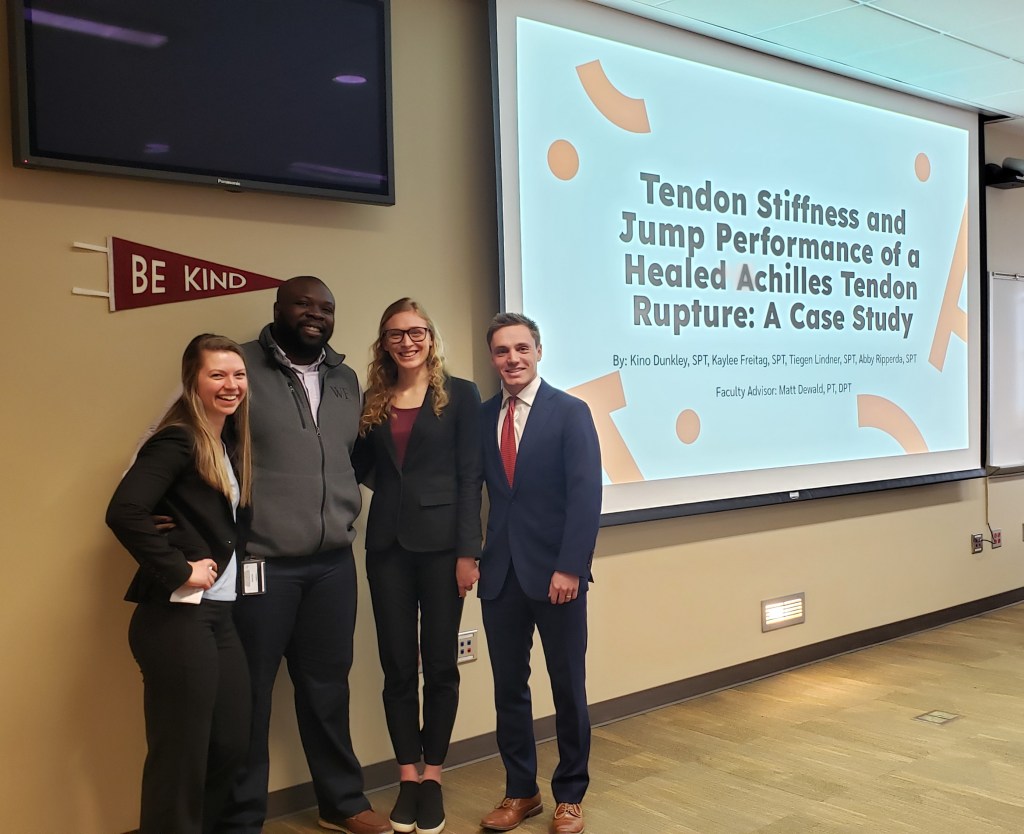
32 Comments on “Tendon Stiffness and Jump Performance of a Healed Achilles Tendon Rupture: A Case Study”
Great job on your project! It was very easy to follow! What was used as the comparison for “normal AT stiffness” in your research? Was a baseline of the injured limb taken, bilateral components, or general Goni norms used as a comparative?
Hi Jocelyn! Thanks for your comment.
As for your question about “normal AT stiffness,” our case study subject acted as “their own control.” Each time they visited us, we took a stiffness measurement 1) prior to intervention / their baseline for the day and 2) directly following intervention. Since our subject’s AT was healed, there was not necessarily a set of values that were designated as “injured” relative to a “non-injured” side. I really like your mention of goni measurements – our primary outcomes of single leg hop, RSI, ground contact time, and tendon stiffness were specifically looking at performance. With further research on this topic, it definitely would be interesting to see if some of the aforementioned metrics / outcomes would relate to increases in DF ROM, for example – great / interesting point you bring up!
Your project looks really good! Why did you choose these specific interventions for your project, and are there other interventions you believe could be more beneficial for your patient?
Hi Julie! Thanks for your interest in our project.
We chose the interventions of heel raises, knee to wall, and ankle hops because those have been very popular in the literature / previous studies with regard to Achilles tendon metrics and associated performance. Many studies have looked at loading, so we chose heel raises for that. Many have looked at plyometrics, so we looked at ankle hops. Many have analyzed stretching, so we chose the dynamic knee to wall intervention. As for other interventions that we could have used that could have been more beneficial, we would look at other variations of the aforementioned three main areas: loading, plyometrics, and stretching. For loading, future research could look at eccentric heel lowering from a stair, for example. Stretching could take the form of deep DL squats or MET to increase DF, for example. Plyometrics could take the form of single leg horizontal consecutive hops, for example. Lots of options, and I think that is a very interesting point you bring up!
This is a great study and a very informative poster! How would you change the study in the future to conclude whether the Achilles tendon stiffness is advantageous or not? Additionally, how would you measure if the tightness is advantageous?
Hi Kyleigh. Previous research has already concluded that there is an optimal level to which Achilles tendon stiffness is advantageous. Too much stiffness or too little stiffness can decrease Achilles tendon performance and increase risk of injury. Our research focuses on the acute affects of the different interventions and how they affect the tendon stiffness and trying to identify if there is a specific intervention that has a larger affect on Achilles tendon stiffness and jump performance. Regarding your other questions tightness and stiffness are too different ideas. Tightness is oftentimes a subjective feeling to describe how the muscle or tendon often in response to an overuse injury. Stiffness, specifically tendon stiffness refers to the property of the tendon that is shown to be correlated with performance during stretch-shortening cycle exercises. In our study we measured Achilles tendon stiffness using a device called a MyotonPro. This device has been used in previous research to assess tendon stiffness. In future research this device could potentially be used in correlation with jump performance to assess what tendon stiffness is optimal for specific individuals.
Hey guys! Good job on this poster presentation about the tendon stiffness and jump performance of a healed Achilles tendon rupture. We learn a fair amount about the Achilles tendon throughout physical therapy school and the different treatments to address this tendon. There are many different research articles that demonstrate a structured progression of exercises that a patient can perform during rehab for this specific condition or injury. How would you address a patient like the one in your case study compared to an older patient say in their 50s or 60s since many protocols include hopping and other difficult tasks? Also, are there any other devices or strategies that other clinics and researcher articles use to address tendon stiffness and jump performance besides the MyotonPRO and MyJump2?
Hi Andrew, Great questions. To address your first question, the beginning stages of rehab for most individuals following an Achilles Tendon tear with conservative management would be very similar. However, later stages of rehab for Achilles Tendon tears would largely be focused on getting a patient back to the activities they would like to be able to do. Therefore if you were treating an older patient that didn’t have a goal of getting back to jumping/hopping/more difficult tasks that would not be the focus of the rehab as it might be with someone younger and more active like the individual in our case study. As you your second question, the MyotonPRO is the one of the only if not the only device that is currently used to measure tendon stiffness. On the other hand there are several ways to measure jump performance. We used the MyJump2 app as it was convenient and easy to use. However, we could have used a force plate to measure force or devices such as aa tape measure to measure height.
Hey guys! Great job on the poster and research. My question for you is – Do you think that more cases to compare would help you understand if tendon stiffness is advantageous/disadvantageous?
Hey! Thanks Allie. I do think that a larger library of cases to compare different tendon stiffness and objective performance would help to give a better idea of what an ideal tendon stiffness is. The more data, the more confident that you can be in a conclusion. I do know that having a tendon stiffness that is too high or too low can be disadvantageous for performance or put you at risk for injury. I also know that age, gender and BMI do play a role in the mechanical properties of a tendon, so it would be interesting to get more data and see if these properties also correlate with optimal tendon stiffness more individually for people.
Hey Andrew! Thanks for your interest / comments.
First, great point- obviously treatment is going to look different depending on the age and needs of the patient. That said, I personally would look at that patient (say 65yrs of age) and ask what is most important for them. Let’s say, for example, they are retired and their knees present with severe OA- so, they wouldn’t be able to hop etc. Their needs are strictly playing with their grandchildren, performing household chores, and running errands. Since they aren’t able to load a ton due to their knees, I would stay away from hopping while still looking to load the tendon progressively. This could include seated calf raises (without or with weight), standing calf raises (one LE, both LE, eccentric, concentric variations), leg press for calf raises (one LE, both LE, eccentric, concentric variations) – really, we will look to load the tendon anyway that we can without aggravating their knees / staying away from the hopping and high impact, using exercises that are specific to their goals / functional needs. As far as your second question goes, really any slow motion capture system (similar to the jump app) is utilized for assessing biomechanical forces / performance. There have been quite a bit of reliability and validity studies done on the MyotonPRO and its use in assessing stiffness- that was the most widely used that we saw.
Hello! I thought your research was very well done and your poster well organized! I was wondering if you could explain the MyJump2 app further and why it was helpful in gathering data as I am unfamiliar with it.
Hi Cassidy, thank you for your response. So the MyJump2 app is an analytic software that can measure more accurately the biomechanics involved in jump performances such as angles, force production (if coupled with ground force places), contact times and reactive strength index. Currently the MyJump2 app is one of the most valid and reliable softwares out there that allows for the capture of each data point with consistency from one attempt to the next. Given that our study involved multiple repetitions of drop jumps, this was helpful in allowing for efficient capture and intra-session reliability in the results across all attempts and lowered chances for human error. Hopefully this answered your question.
Great job on your research and poster! My question for you is, did you feel like you had any limitations to your study, that if changed, would have helped discover the role that achilles tendon tightness played in function?
Great job with your poster! I know you stated that you were not certain whether increased stiffness was advantageous for this case. Could you expand upon that? Was there some sort of activity that this individual was hoping to return to that made this inconclusive in this regard, or what would have been the marker of increased stiffness being advantageous? (Please let me know if that doesn’t make sense)
Hey Janai! Thanks for the response. Extreme tendon stiffness in general is not advantageous, so it is not just for this case. The ideal tendon stiffness is not known, but tendons of increased or decreased stiffness can be dangerous. With increased stiffness you lose the ability to adapt and spring resulting in a tear. With very low stiffness you lack the ability to spring in response to loading. This individual was not looking to get back to anything in particular. This participant was just looking to maintain a healthy lifestyle with movement. Thank you for your question and I hope I was able to answer it for you!
Hi Parker, thanks for your interest in our poster.
Below are the main limitations of our study that were described in our manuscript:
“As for limitations within the study, there are multiple that the researchers would like to propose. First, although subjects were randomly assigned to each intervention and thus received the three interventions in a different order, a training effect with specific regard to familiarization of the pre- and post- intervention measures could be a limitation. Later in the study, subjects may have experienced an increase in performance since they already participated in two other sessions and thus already familiarized themselves with the testing protocol. Specificity was also a limitation in this study, as the ankle hop intervention did not match the type of jump assessed with testing. The ankle hop intervention included double limb hopping whereas the jump assessment within the testing protocol included a single leg hop. Additionally, inclusion criteria for the present study consisted of students from the University of South Dakota, both males and females. However, all five subjects that participated were female, and therefore the researchers are not able to confidently generalize findings to populations. Lastly, the present study spans just over two weeks in length which serves as another possible limitation. Subjects may not perform to their fullest potential throughout the study due to possible disinterest, thus limiting the validity and reliability of data gathered from that subject at that time. All aforementioned limitations serve as potential bias within the present study. As such, the external validity is low due to said limitations and results are unable to be generalized to populations outside the demographics of subjects in the present study.”
Since you it was not found if tendon tightness is advantageous or not. What is a way you believe you could test this to assess if tendon tightness is advantageous or not?
Hey Tonner! Thanks for the question. I believe that it would take a lot of collected data to identify a tendon stiffness that is advantageous. Many studies would have to be completed with different athletes. You would want to collect information like height, weight, gender, vertical, ground contact time, age, max speed, history of injuries and stiffness. It would also be helpful to do a study over the years of peoples lives so that you could observe how each variable changes. I think you could also possibly identify different ideal tendon stiffness’s for desired performance whether it be jumping or sprinting or long distance running.
Great job on your presentation! I was wondering if you did any comparisons to the subjects healthy achilles to see if the tendon stiffness was the same in comparison for pre- and post- intervention? Also, in the conclusion/clinical relevance portion you state that the heel raises were the most favorable intervention, do you mean this from the patients point of view or from the researcher’s?
Hi Jack, thanks for your interest in our research. Yes, we did comparisons in that each time the subject visited for testing / treatment, both LE’s were assessed. We were not necessarily looking at her healed AT versus her noninvolved AT, more so the immediate effects of intervention on overall performance. But, if you really wanted to assess LE to LE, yes you would be able to do that as we tested both AT’s for pre and post testing. As to your second questions, data told us that the heel raises were most beneficial, so neither point of view- the numbers told us.
Good job on your research. When looking at the improved ground contact time, how do you think incorporating activities that improve ground contact time could help patients improve their quality of life or activities of daily living?
Hey Jett! Thanks for the question! Like you know, our treatments are tailored to our patients needs and goals. Ground contact time does not appear to have any specific link to general activities of daily living. If you’re working with an 80 year old who has a history of falls, ground contact time is not something you would want to include in your treatment. Ground contact time can be advantageous to work on for athletes who need to move quick. Thanks again for the question. If my response does not answer what you were intending or doesn’t make sense let me know!
Hello! Great job with your poster, I found this very interesting to read and learn more about. How did you decide on which interventions to use in your study, or what did that process look like?
Hey Lexie! Thanks for your question. Research was done before the design and completion of our study. In doing research we identified 3 intervention categories that we wanted to investigate for their effects on our dependent variables. We identified a plyometric, a dynamic stretch as well as a loading activity. These are common avenues for athletes warm up before sport participation. With our research, we looked at other studies that had performed similar investigations and the interventions that they used. We thought about what interventions would be plausible and available for us to do. We also had to think about interventions that our subjects would be willing to participate in and interventions that would not put our subjects at a high risk for injury. How this response was helpful. Thanks again for the question!
Hi Lexie, thanks for your interest in our research. A multitude of studies have assessed long term effects of strength / loading, plyometrics, and stretching on AT performance. Specifically, we have seen heel raises, DL hopping, and dynamic knee to wall stretching being used in the literature. Thus, that is how we decided upon our interventions.
Nice work on your research poster! I have a few questions for you guys after looking it over. What was the control or placebo for this study? Also, did you guys think about comparing the previously ruptured tendon to a healthy individual’s tendons who was similar in age?
Hi Joseph, thanks for your interest in our research. First, the subject of our case study (and every other subject in the research project for that matter) acted as their own control. In other words, each and every time they visited the lab, we got “new” pre intervention data on them. Thus, we were simply assessing the immediate effect of the intervention between their pre intervention data and most intervention data. As to your second question, we assessed both LE’s / both AT’s for each and every subject. So, technically, we were assessing 2 AT’s for our one case study subject, or 10 AT’s for our 5 total subjects.
Great research! I found it very interesting! I am curious as to how you decided on the exercises you chose for the intervention? If you could replicate this study, what factors would you change based on your outcome measures?
Hi Grace, thanks for your interest in our research. First, previous literature prompted us to use the interventions we did- but, contrary to previous research, we looked at the immediate effects of those interventions instead of long-term effects. As to your second question, there are a number of factors we could change if we were to replicate this study, such as the amount of total load for each intervention, the number of visits for each subject, or time between each visit. Specifically looking at varying factors in terms of outcome measures, we could definitely look to do a DL hop for time, power, speed etc. instead of a SL hop- we could also add other performance measures such as triple hop for distance.
Hey guys! Excellent job on the research poster! It is very easy to follow and well organized. Do you guys plan to further explore this topic? If so, what would you focus on analyzing, or how would you adjust to compensate for any current limitations?
Hi Lexi, thanks for your interest in our research. I think there are multiple directions for this research topic to expand upon- however, it sounds like Dr. Dewald and his 2nd year students are analyzing dynamic knee valgus currently. If we were to continue this research, we would look to include more individuals / males in order to increase generalizability. Another change could be including a DL hop test in pre intervention and post intervention testing in order to match the intervention of DL hopping to a greater extent. Also, altering the amount of time for the entire study may improve the study’s power in the future.



Great job on your project! It was very easy to follow! What was used as the comparison for “normal AT stiffness” in your research? Was a baseline of the injured limb taken, bilateral components, or general Goni norms used as a comparative?
LikeLike
Hi Jocelyn! Thanks for your comment.
As for your question about “normal AT stiffness,” our case study subject acted as “their own control.” Each time they visited us, we took a stiffness measurement 1) prior to intervention / their baseline for the day and 2) directly following intervention. Since our subject’s AT was healed, there was not necessarily a set of values that were designated as “injured” relative to a “non-injured” side. I really like your mention of goni measurements – our primary outcomes of single leg hop, RSI, ground contact time, and tendon stiffness were specifically looking at performance. With further research on this topic, it definitely would be interesting to see if some of the aforementioned metrics / outcomes would relate to increases in DF ROM, for example – great / interesting point you bring up!
LikeLike
Your project looks really good! Why did you choose these specific interventions for your project, and are there other interventions you believe could be more beneficial for your patient?
LikeLike
Hi Julie! Thanks for your interest in our project.
We chose the interventions of heel raises, knee to wall, and ankle hops because those have been very popular in the literature / previous studies with regard to Achilles tendon metrics and associated performance. Many studies have looked at loading, so we chose heel raises for that. Many have looked at plyometrics, so we looked at ankle hops. Many have analyzed stretching, so we chose the dynamic knee to wall intervention. As for other interventions that we could have used that could have been more beneficial, we would look at other variations of the aforementioned three main areas: loading, plyometrics, and stretching. For loading, future research could look at eccentric heel lowering from a stair, for example. Stretching could take the form of deep DL squats or MET to increase DF, for example. Plyometrics could take the form of single leg horizontal consecutive hops, for example. Lots of options, and I think that is a very interesting point you bring up!
LikeLike
This is a great study and a very informative poster! How would you change the study in the future to conclude whether the Achilles tendon stiffness is advantageous or not? Additionally, how would you measure if the tightness is advantageous?
LikeLike
Hi Kyleigh. Previous research has already concluded that there is an optimal level to which Achilles tendon stiffness is advantageous. Too much stiffness or too little stiffness can decrease Achilles tendon performance and increase risk of injury. Our research focuses on the acute affects of the different interventions and how they affect the tendon stiffness and trying to identify if there is a specific intervention that has a larger affect on Achilles tendon stiffness and jump performance. Regarding your other questions tightness and stiffness are too different ideas. Tightness is oftentimes a subjective feeling to describe how the muscle or tendon often in response to an overuse injury. Stiffness, specifically tendon stiffness refers to the property of the tendon that is shown to be correlated with performance during stretch-shortening cycle exercises. In our study we measured Achilles tendon stiffness using a device called a MyotonPro. This device has been used in previous research to assess tendon stiffness. In future research this device could potentially be used in correlation with jump performance to assess what tendon stiffness is optimal for specific individuals.
LikeLike
Hey guys! Good job on this poster presentation about the tendon stiffness and jump performance of a healed Achilles tendon rupture. We learn a fair amount about the Achilles tendon throughout physical therapy school and the different treatments to address this tendon. There are many different research articles that demonstrate a structured progression of exercises that a patient can perform during rehab for this specific condition or injury. How would you address a patient like the one in your case study compared to an older patient say in their 50s or 60s since many protocols include hopping and other difficult tasks? Also, are there any other devices or strategies that other clinics and researcher articles use to address tendon stiffness and jump performance besides the MyotonPRO and MyJump2?
LikeLike
Hi Andrew, Great questions. To address your first question, the beginning stages of rehab for most individuals following an Achilles Tendon tear with conservative management would be very similar. However, later stages of rehab for Achilles Tendon tears would largely be focused on getting a patient back to the activities they would like to be able to do. Therefore if you were treating an older patient that didn’t have a goal of getting back to jumping/hopping/more difficult tasks that would not be the focus of the rehab as it might be with someone younger and more active like the individual in our case study. As you your second question, the MyotonPRO is the one of the only if not the only device that is currently used to measure tendon stiffness. On the other hand there are several ways to measure jump performance. We used the MyJump2 app as it was convenient and easy to use. However, we could have used a force plate to measure force or devices such as aa tape measure to measure height.
LikeLike
Hey guys! Great job on the poster and research. My question for you is – Do you think that more cases to compare would help you understand if tendon stiffness is advantageous/disadvantageous?
LikeLike
Hey! Thanks Allie. I do think that a larger library of cases to compare different tendon stiffness and objective performance would help to give a better idea of what an ideal tendon stiffness is. The more data, the more confident that you can be in a conclusion. I do know that having a tendon stiffness that is too high or too low can be disadvantageous for performance or put you at risk for injury. I also know that age, gender and BMI do play a role in the mechanical properties of a tendon, so it would be interesting to get more data and see if these properties also correlate with optimal tendon stiffness more individually for people.
LikeLike
Hey Andrew! Thanks for your interest / comments.
First, great point- obviously treatment is going to look different depending on the age and needs of the patient. That said, I personally would look at that patient (say 65yrs of age) and ask what is most important for them. Let’s say, for example, they are retired and their knees present with severe OA- so, they wouldn’t be able to hop etc. Their needs are strictly playing with their grandchildren, performing household chores, and running errands. Since they aren’t able to load a ton due to their knees, I would stay away from hopping while still looking to load the tendon progressively. This could include seated calf raises (without or with weight), standing calf raises (one LE, both LE, eccentric, concentric variations), leg press for calf raises (one LE, both LE, eccentric, concentric variations) – really, we will look to load the tendon anyway that we can without aggravating their knees / staying away from the hopping and high impact, using exercises that are specific to their goals / functional needs. As far as your second question goes, really any slow motion capture system (similar to the jump app) is utilized for assessing biomechanical forces / performance. There have been quite a bit of reliability and validity studies done on the MyotonPRO and its use in assessing stiffness- that was the most widely used that we saw.
LikeLike
Hello! I thought your research was very well done and your poster well organized! I was wondering if you could explain the MyJump2 app further and why it was helpful in gathering data as I am unfamiliar with it.
LikeLike
Hi Cassidy, thank you for your response. So the MyJump2 app is an analytic software that can measure more accurately the biomechanics involved in jump performances such as angles, force production (if coupled with ground force places), contact times and reactive strength index. Currently the MyJump2 app is one of the most valid and reliable softwares out there that allows for the capture of each data point with consistency from one attempt to the next. Given that our study involved multiple repetitions of drop jumps, this was helpful in allowing for efficient capture and intra-session reliability in the results across all attempts and lowered chances for human error. Hopefully this answered your question.
LikeLike
Great job on your research and poster! My question for you is, did you feel like you had any limitations to your study, that if changed, would have helped discover the role that achilles tendon tightness played in function?
LikeLike
Great job with your poster! I know you stated that you were not certain whether increased stiffness was advantageous for this case. Could you expand upon that? Was there some sort of activity that this individual was hoping to return to that made this inconclusive in this regard, or what would have been the marker of increased stiffness being advantageous? (Please let me know if that doesn’t make sense)
LikeLike
Hey Janai! Thanks for the response. Extreme tendon stiffness in general is not advantageous, so it is not just for this case. The ideal tendon stiffness is not known, but tendons of increased or decreased stiffness can be dangerous. With increased stiffness you lose the ability to adapt and spring resulting in a tear. With very low stiffness you lack the ability to spring in response to loading. This individual was not looking to get back to anything in particular. This participant was just looking to maintain a healthy lifestyle with movement. Thank you for your question and I hope I was able to answer it for you!
LikeLike
Hi Parker, thanks for your interest in our poster.
Below are the main limitations of our study that were described in our manuscript:
“As for limitations within the study, there are multiple that the researchers would like to propose. First, although subjects were randomly assigned to each intervention and thus received the three interventions in a different order, a training effect with specific regard to familiarization of the pre- and post- intervention measures could be a limitation. Later in the study, subjects may have experienced an increase in performance since they already participated in two other sessions and thus already familiarized themselves with the testing protocol. Specificity was also a limitation in this study, as the ankle hop intervention did not match the type of jump assessed with testing. The ankle hop intervention included double limb hopping whereas the jump assessment within the testing protocol included a single leg hop. Additionally, inclusion criteria for the present study consisted of students from the University of South Dakota, both males and females. However, all five subjects that participated were female, and therefore the researchers are not able to confidently generalize findings to populations. Lastly, the present study spans just over two weeks in length which serves as another possible limitation. Subjects may not perform to their fullest potential throughout the study due to possible disinterest, thus limiting the validity and reliability of data gathered from that subject at that time. All aforementioned limitations serve as potential bias within the present study. As such, the external validity is low due to said limitations and results are unable to be generalized to populations outside the demographics of subjects in the present study.”
LikeLike
Since you it was not found if tendon tightness is advantageous or not. What is a way you believe you could test this to assess if tendon tightness is advantageous or not?
LikeLike
Hey Tonner! Thanks for the question. I believe that it would take a lot of collected data to identify a tendon stiffness that is advantageous. Many studies would have to be completed with different athletes. You would want to collect information like height, weight, gender, vertical, ground contact time, age, max speed, history of injuries and stiffness. It would also be helpful to do a study over the years of peoples lives so that you could observe how each variable changes. I think you could also possibly identify different ideal tendon stiffness’s for desired performance whether it be jumping or sprinting or long distance running.
LikeLike
Great job on your presentation! I was wondering if you did any comparisons to the subjects healthy achilles to see if the tendon stiffness was the same in comparison for pre- and post- intervention? Also, in the conclusion/clinical relevance portion you state that the heel raises were the most favorable intervention, do you mean this from the patients point of view or from the researcher’s?
LikeLike
Hi Jack, thanks for your interest in our research. Yes, we did comparisons in that each time the subject visited for testing / treatment, both LE’s were assessed. We were not necessarily looking at her healed AT versus her noninvolved AT, more so the immediate effects of intervention on overall performance. But, if you really wanted to assess LE to LE, yes you would be able to do that as we tested both AT’s for pre and post testing. As to your second questions, data told us that the heel raises were most beneficial, so neither point of view- the numbers told us.
LikeLike
Good job on your research. When looking at the improved ground contact time, how do you think incorporating activities that improve ground contact time could help patients improve their quality of life or activities of daily living?
LikeLike
Hey Jett! Thanks for the question! Like you know, our treatments are tailored to our patients needs and goals. Ground contact time does not appear to have any specific link to general activities of daily living. If you’re working with an 80 year old who has a history of falls, ground contact time is not something you would want to include in your treatment. Ground contact time can be advantageous to work on for athletes who need to move quick. Thanks again for the question. If my response does not answer what you were intending or doesn’t make sense let me know!
LikeLike
Hello! Great job with your poster, I found this very interesting to read and learn more about. How did you decide on which interventions to use in your study, or what did that process look like?
LikeLike
Hey Lexie! Thanks for your question. Research was done before the design and completion of our study. In doing research we identified 3 intervention categories that we wanted to investigate for their effects on our dependent variables. We identified a plyometric, a dynamic stretch as well as a loading activity. These are common avenues for athletes warm up before sport participation. With our research, we looked at other studies that had performed similar investigations and the interventions that they used. We thought about what interventions would be plausible and available for us to do. We also had to think about interventions that our subjects would be willing to participate in and interventions that would not put our subjects at a high risk for injury. How this response was helpful. Thanks again for the question!
LikeLike
Hi Lexie, thanks for your interest in our research. A multitude of studies have assessed long term effects of strength / loading, plyometrics, and stretching on AT performance. Specifically, we have seen heel raises, DL hopping, and dynamic knee to wall stretching being used in the literature. Thus, that is how we decided upon our interventions.
LikeLike
Nice work on your research poster! I have a few questions for you guys after looking it over. What was the control or placebo for this study? Also, did you guys think about comparing the previously ruptured tendon to a healthy individual’s tendons who was similar in age?
LikeLike
Hi Joseph, thanks for your interest in our research. First, the subject of our case study (and every other subject in the research project for that matter) acted as their own control. In other words, each and every time they visited the lab, we got “new” pre intervention data on them. Thus, we were simply assessing the immediate effect of the intervention between their pre intervention data and most intervention data. As to your second question, we assessed both LE’s / both AT’s for each and every subject. So, technically, we were assessing 2 AT’s for our one case study subject, or 10 AT’s for our 5 total subjects.
LikeLike
Great research! I found it very interesting! I am curious as to how you decided on the exercises you chose for the intervention? If you could replicate this study, what factors would you change based on your outcome measures?
LikeLike
Hi Grace, thanks for your interest in our research. First, previous literature prompted us to use the interventions we did- but, contrary to previous research, we looked at the immediate effects of those interventions instead of long-term effects. As to your second question, there are a number of factors we could change if we were to replicate this study, such as the amount of total load for each intervention, the number of visits for each subject, or time between each visit. Specifically looking at varying factors in terms of outcome measures, we could definitely look to do a DL hop for time, power, speed etc. instead of a SL hop- we could also add other performance measures such as triple hop for distance.
LikeLike
Hey guys! Excellent job on the research poster! It is very easy to follow and well organized. Do you guys plan to further explore this topic? If so, what would you focus on analyzing, or how would you adjust to compensate for any current limitations?
LikeLike
Hi Lexi, thanks for your interest in our research. I think there are multiple directions for this research topic to expand upon- however, it sounds like Dr. Dewald and his 2nd year students are analyzing dynamic knee valgus currently. If we were to continue this research, we would look to include more individuals / males in order to increase generalizability. Another change could be including a DL hop test in pre intervention and post intervention testing in order to match the intervention of DL hopping to a greater extent. Also, altering the amount of time for the entire study may improve the study’s power in the future.
LikeLike